Severance isn’t just another clever sci-fi drama.
It is the rare series that trusts its audience, challenges perception, and builds meaning through silence, structure, symbolism and emotional precision.
In a TV landscape dominated by noise, Severance stands out as a show that rewards attention, memory, and interpretation.
Here’s why it might be the smartest show of the last 10 years.
1. A Concept That Works on Every Level
At its core, Severance is a simple question:
What if your work self and your home self were completely separated?
But the brilliance is how the show uses this concept:
✔ Psychological metaphor
The “innie” represents your anxious, overworked self.
The “outie” represents the version of you that pretends everything is fine.
✔ Corporate commentary
Lumen is not a company — it is a religion, a machine, a worldview.
Employees don’t work for Lumen; they belong to it.
✔ Existential experiment
If one version of you suffers and the other escapes,
who are you really?
Few shows weave metaphor and narrative this cleanly.
2. The Best Worldbuilding Since Westworld Season 1
Most sci-fi shows explain their world constantly.
Severance refuses.
You discover the rules the same way the characters do:
- Strange office rituals
- Creepy onboarding scripts
- Incentive programs that feel like propaganda
- Corporate hymns
- “Perpetuity Wing” — a museum of obedient workers
- Murals that look like silent warnings
Everything is unsettling because everything is almost normal.
This is worldbuilding through implication, not exposition.
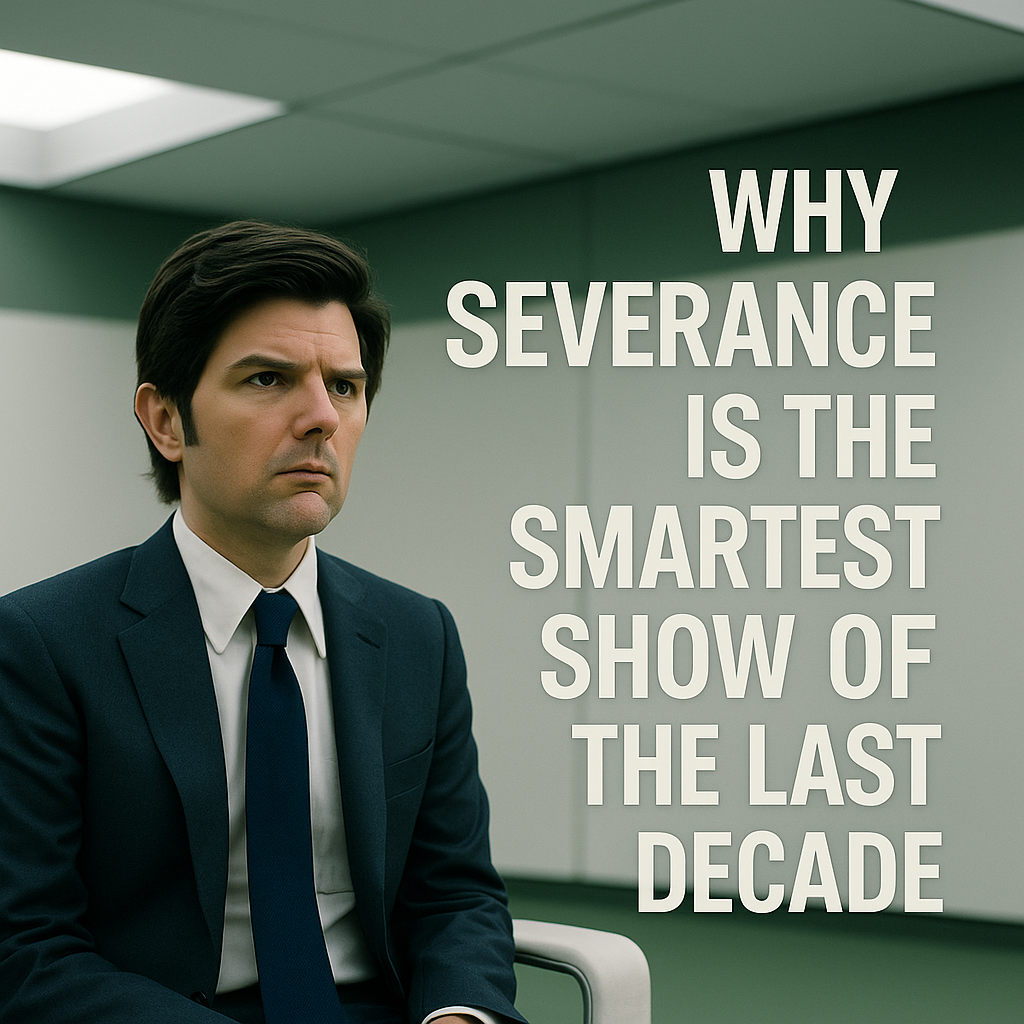
3. Visual Language That Tells the Story for You
Severance uses images the way great literature uses symbolism.
🟦 The office
A sterile maze with no windows → psychological imprisonment.
🟩 The green hallway
A subtle color insult to the human mind — calming but disorienting.
🟥 The break room
The place where punishment is disguised as therapy.
⚪ The severance chip
A literal switch that turns you into someone else.
🚪 Doorway transitions
“innie → outie” shifts visualized with quiet cuts, sharp framing, and stillness.
Every frame feels like it was designed by someone who hates lazy viewers.
4. Character Writing That Rewards Close Watching
Mark Scout
A man grieving so deeply that he willingly signs away half his life.
One of the most tragic protagonists in modern TV.
Helly
The innie who refuses to accept her own existence.
A rebellion in human form.
Irving
A loyal soldier of the system…
…who is secretly unraveling.
Dylan
Comic relief on the surface — emotional core underneath.
Each character is a mirror:
- Mark: denial
- Helly: resistance
- Irving: indoctrination
- Dylan: humanity trying to survive the machine
No character is wasted.
No arc is random.
5. The Deep Themes Nobody Else Is Handling This Well
⭐ The illusion of work-life balance
The show asks:
Is separation freedom, or a new kind of slavery?
⭐ The morality of labor
If your “innie” suffers and you don’t remember it…
are you accountable?
⭐ Identity
You are the sum of your memories —
remove them, and you become a ghost.
⭐ Corporate control
Lumen is the perfect representation of companies that want devotion, not labor.
6. The Structure Is Designed Like a Puzzle
Severance doesn’t spoon-feed you.
It uses:
- slow-burn tension
- hidden parallels
- quiet recurring motifs
- incomplete information
- emotionally loaded silence
The show is engineered like a puzzle box:
- pieces appear out of order
- you assemble meaning retroactively
- the emotional payoff arrives suddenly and violently
Season 1’s finale is one of the best in modern TV because everything converges:
- plot
- character
- symbolism
- themes
- suspense
It’s writing done by people who respect the viewer’s intelligence.
7. The Finale Is a Masterclass in Controlled Chaos
Without spoilers:
- Every character hits their emotional peak
- Every plotline escalates at once
- Every reveal lands
- Every second is purposeful
- Nothing feels cheap
It’s the rare finale that expands the mystery and delivers explosive payoff.
8. Why Severance Feels Like a “New Classic”
Because it behaves like prestige literature:
- slow characterization
- layered themes
- intentional storytelling
- motivated symbolism
- psychological depth
- aesthetic discipline
While other shows chase trends, Severance builds a world that feels timeless.
⭐ Final Verdict: Why It’s the Smartest Show of the Last Decade
Severance is a rare achievement:
- original
- philosophical
- emotional
- visually precise
- thematically dangerous
- narratively disciplined
- intellectually respectful
It’s a show that understands both the modern human mind and the modern corporate machine — and it critiques both with elegance and savagery.
This isn’t entertainment.
It’s an autopsy of modern identity.