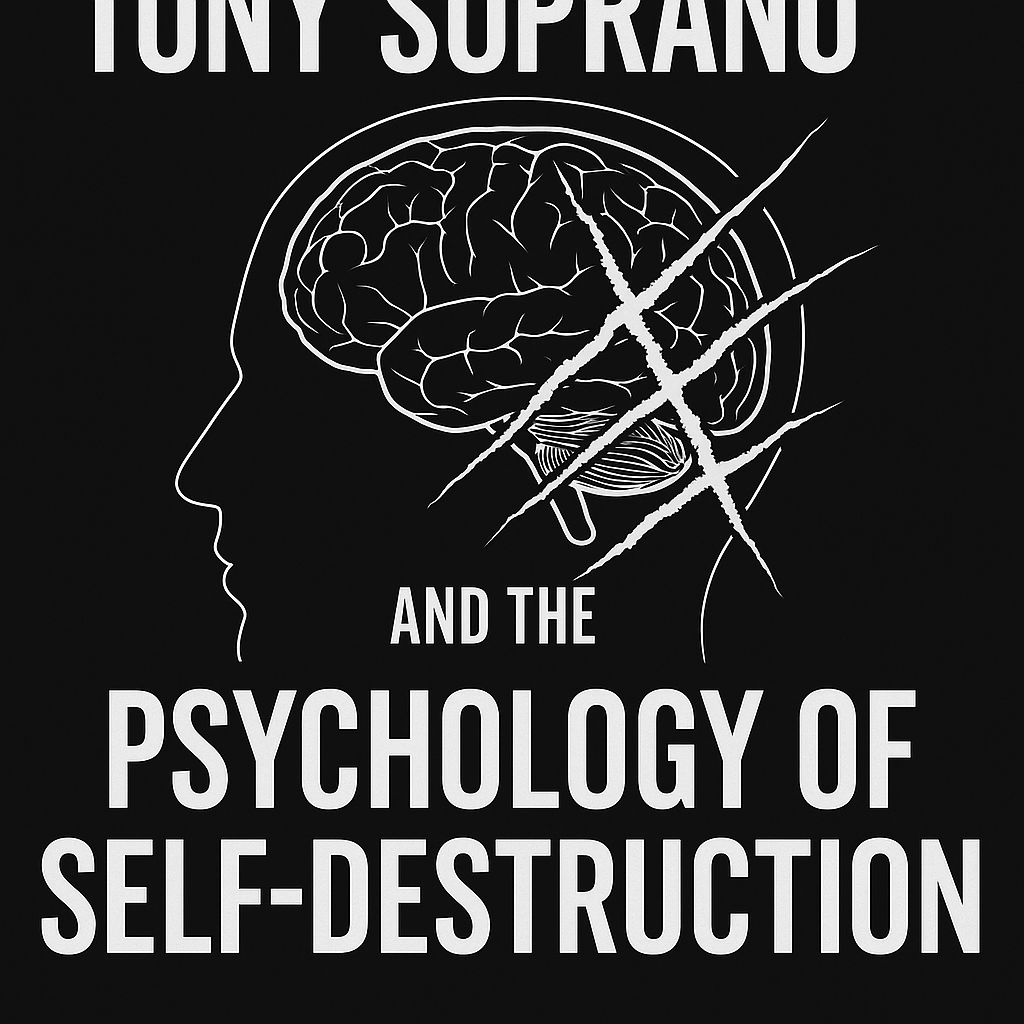
Why The Sopranos Created the Most Complex Character in Television History
Tony Soprano didn’t just redefine antiheroes.
He reshaped the entire language of modern television.
Long before Walter White or Don Draper, Tony was the blueprint:
a man whose personal war wasn’t with law enforcement or rival mobsters —
but with his own mind.
The Sopranos is not about mafia power.
It’s about identity fracture, emotional repression, and the slow, painful collapse of a man who cannot escape himself.
This analysis breaks down the psychological architecture behind Tony Soprano and why his self-destruction feels inevitable.
🟦 1. Tony Soprano: A Man Split in Two
From the opening episode, Tony is introduced as a man living two incompatible lives:
- the violent, hierarchical world of organized crime
- the suburban American family ideal he desperately wants to believe in
Tony’s crisis is not external — it is dual identity incompatibility.
He wants:
- power and peace
- authority and affection
- dominance and safety
- cruelty and love
His entire arc is the psychological tension between these worlds tearing him apart.
🟦 2. The Panic Attacks — A Manifestation of Buried Trauma
Tony’s panic attacks are not random symptoms.
They are metaphoric eruptions of:
- childhood wounds
- unresolved guilt
- violent repression
- emotional conflict
- identity confusion
Every collapse signals the moments where Tony’s brain refuses to continue lying to itself.
He doesn’t have panic attacks because he’s weak.
He has panic attacks because the persona he lives is incompatible with the person he is.
🟦 3. Tony’s Core Wound: His Mother
Livia Soprano is the origin of Tony’s emotional disfigurement.
Traits she imprinted onto him:
- emotional withholding
- conditional affection
- manipulation as communication
- guilt as control
- love as punishment
- affection as threat
Tony spends the series trying to break the cycle —
yet continually becomes a mirror of the thing he fears most.
Livia is the ghost that haunts every bad decision Tony makes.
🟦 4. Therapy as a Battlefield
Tony doesn’t go to therapy to change.
He goes to therapy to survive.
But this creates a paradox:
- Therapy requires vulnerability.
- Tony’s world punishes vulnerability with death.
Dr. Melfi becomes a proxy mother, confessor, and emotional witness.
Tony desperately needs her but also resents her.
Why?
Because she represents the version of himself he fears becoming:
a man who confronts feelings instead of burying them.
Every therapy scene is a psychological duel between two versions of Tony.
🟦 5. Tony’s Violence: Not Strategy, but Compulsion
Unlike classic mob characters, Tony doesn’t use violence as calculated leadership.
His violence is:
- impulsive
- emotional
- compensatory
- a form of self-medication
Every violent act is tied to:
- humiliation
- insecurity
- fear of loss
- paranoia
- emasculation
- the need to reassert dominance
Violence for Tony isn’t just power.
It’s identity maintenance.
🟦 6. The Myth of the Family Man
Tony’s suburban life is a fragile lie he desperately tries to believe.
He repeats:
- “Everything I do is for my family.”
But the show exposes this as delusion.
Tony does not destroy himself because of his family.
He destroys himself because he tries to have two lives that cannot coexist.
Carmela sees it.
Meadow senses it.
AJ absorbs it and collapses under it.
Tony’s “family man” identity is a mask cracking from the first episode.
🟦 7. Addiction, Escapism, and the Futility of Pleasure
Tony’s addictions — sex, food, gambling, power — are not indulgences.
They are escape mechanisms.
Every pleasure is a temporary exit from the prison of his own mind.
The tragedy:
Every escape increases the very pain he is trying to avoid.
Tony’s life is a loop:
Pain → Escape → Guilt → Anger → More Pain
He is living a closed-circuit emotional system with no exit.
🟦 8. Tony and Carmela — A Marriage Built on Mutual Denial
Their relationship works only because both refuse to face the truth.
Carmela denies:
- Tony’s infidelity
- his criminality
- her complicity
- her own desires
Tony denies:
- his emotional dependence on her
- his fear of abandonment
- his guilt
- his need for connection
They love each other —
but their love is suffocated by the lies they both rely on.
🟦 9. The Psychology of Self-Destruction
Tony repeatedly sabotages:
- his health
- his marriage
- his friendships
- his leadership
- his emotional growth
- his safety
Why?
Because Tony doesn’t believe he deserves peace.
Every step toward healing is met with:
- rage
- regression
- denial
- violence
His psyche is built on self-annihilation.
Not because he wants to die —
but because he doesn’t know how to live without conflict.
🟦 10. The Ending — A Perfect Psychological Truth
Regardless of how viewers interpret the finale (death or survival),
one truth is constant:
Tony lives in a state where danger never ends.
The final cut to black is:
- his paranoia made literal
- the collapse of control
- the impossibility of peace
- the psychological truth of his existence
The ending is not about whether Tony dies.
It’s about the fact that Tony can never escape his own mind.
🟥 Conclusion: Tony Soprano Is the Most Important Character in TV History
Because he is:
- emotionally real
- psychologically layered
- morally contradictory
- self-destructive
- wounded
- charismatic
- terrifying
- deeply human
He showed television that characters could be portraits of the human psyche —
not just protagonists.
Tony Soprano isn’t memorable because he is a mob boss.
He is memorable because he is a man who cannot stop destroying himself.
And that truth keeps The Sopranos timeless.