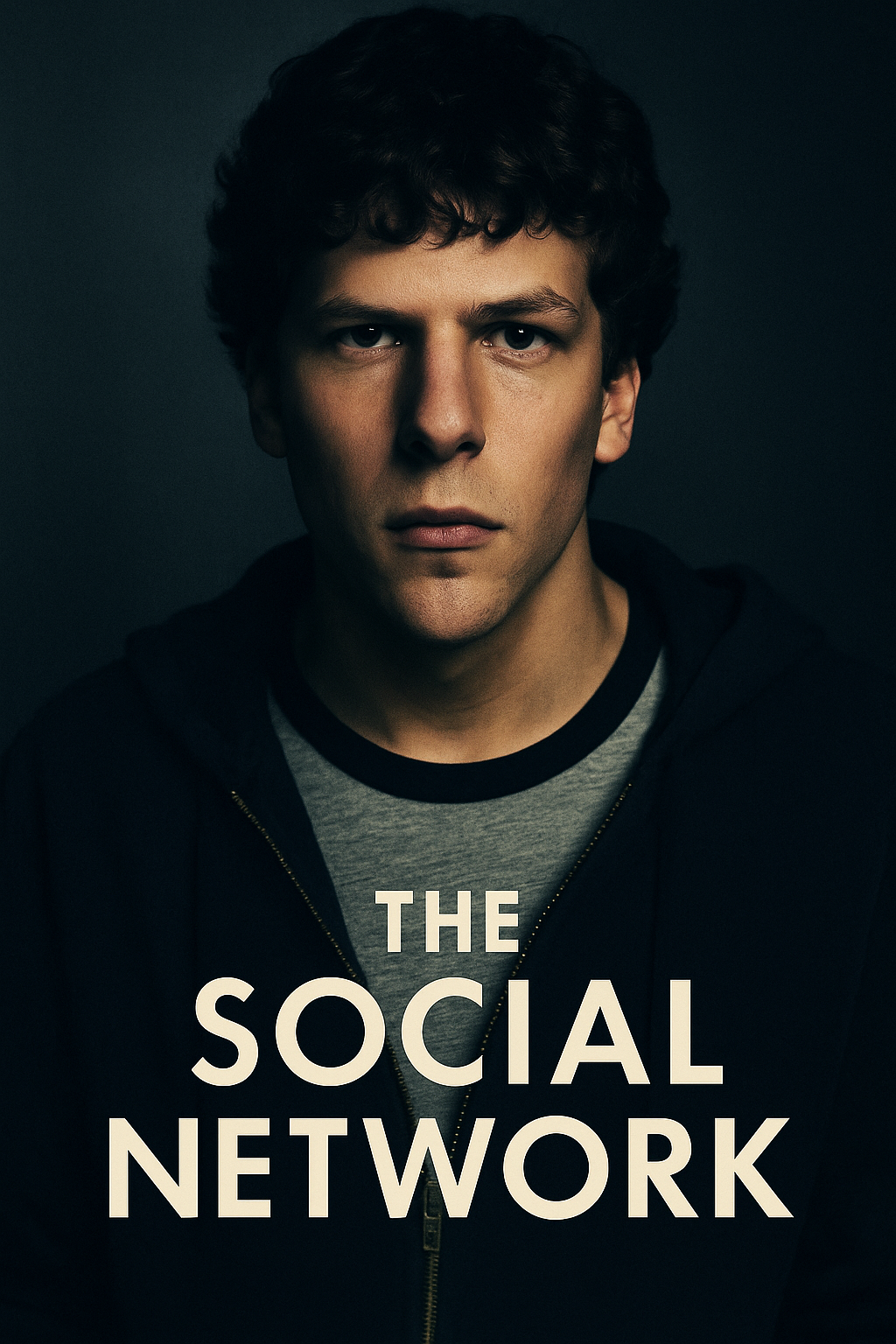
How a film about coding, lawsuits, and college friendships became the most accurate portrait of modern ambition.
🟥 Introduction: The Social Network Isn’t About Facebook — It’s About Human Nature
When The Social Network premiered in 2010, many people expected a tech biopic.
Instead, David Fincher delivered a Shakespearean drama wrapped in:
- litigation scenes
- betrayal
- obsession
- ambition
- intellectual rivalry
- emotional isolation
The film isn’t really about the invention of Facebook.
It’s about:
- validation
- power
- class resentment
- fractured friendship
- the psychological cost of genius
- the loneliness of ambition
This analysis breaks down why The Social Network remains the most precise character study of the 2010s — and why it’s a masterpiece of structure, performance, and thematic depth.
🟥 1. Dual-Deposition Structure: Fincher’s Storytelling Masterstroke
The film’s narrative engine is built on two deposition hearings running in parallel:
1. Eduardo Saverin deposition
(Emotional betrayal, financial conflict, friendship collapse)
2. Winklevoss twins deposition
(Intellectual conflict, ethical ambiguity, social class tension)
This dual structure serves two purposes:
⭐ Purpose #1: Truth becomes subjective
Each deposition:
- contradicts the other
- reframes events
- distorts intentions
- redefines alliances
Sorkin’s script makes it clear:
“There’s your version, their version, and the version that lives somewhere in between.”
Fincher never confirms which one is “true.”
Because the film is not about facts.
It’s about perspective.
⭐ Purpose #2: Mark is defined by other people’s memories
The film never shows Mark Zuckerberg alone in pure objectivity.
Everything about him is filtered through:
- anger
- resentment
- insecurity
- jealousy
- frustration
- emotional wounds
The structure makes Mark a fractured protagonist —
a man shaped by other people’s interpretations.
This is why he’s compelling.
🟥 2. Mark Zuckerberg: The Loneliest Genius in Modern Cinema
Jesse Eisenberg’s performance is iconic because he avoids clichés:
- not socially incompetent
- not emotionless
- not a “misunderstood genius”
- not a villain
Instead, we get something far more interesting:
⭐ A brilliant mind trapped inside emotional immaturity.
Mark’s core traits:
- rapid cognition
- extreme focus
- intellectual dominance
- social hypersensitivity
- inability to process rejection
- desperate need for superiority
- fear of insignificance
His fatal flaw:
He values being right more than being loved.
This is why the film hits so hard.
He creates the world’s largest social network while destroying his own social life.
🟥 3. Eduardo Saverin: The Heart of the Film
Andrew Garfield delivers the emotional spine of the story.
Eduardo represents:
- loyalty
- sincerity
- emotional intelligence
- nostalgia for true friendship
His tragedy is simple:
He believed Facebook was built on friendship.
Mark believed it was built on domination.
The break between Mark and Eduardo isn’t about money.
It’s about values.
Eduardo wanted partnership.
Mark wanted control.
Their relationship is the film’s real love story —
and the breakup scene is its emotional climax.
🟥 4. Sean Parker: The Ghost of Future Mark
Justin Timberlake’s Sean Parker is not a tech mentor.
He is:
- Mark’s future self
- ego unrestrained
- insecurity disguised as swagger
- the seductive voice of ambition
Sean represents the world Mark wants:
- fame
- power
- cultural impact
- revenge against those who mocked him
Sean feeds Mark’s darkest impulses:
“Drop the ‘The.’ Just Facebook. It’s cleaner.”
This isn’t branding advice —
it’s psychological dominance.
Sean validates Mark’s worldview:
- destroy competition
- think globally
- move fast
- break friendships
- treat loyalty as weakness
In the structure of the film, Sean is the devil on Mark’s shoulder —
and Eduardo is the angel he ignores.
🟥 5. The Winklevoss Twins: Class Conflict Disguised as Intellectual Conflict
The Winklevosses are not villains.
They are symbols.
They represent:
- privilege
- tradition
- inherited wealth
- elite social hierarchy
Mark represents:
- outsider resentment
- intellectual superiority
- disruptive ambition
- revenge through innovation
When Cameron says:
“We were gentlemen of Harvard.”
Mark’s response is clear:
He doesn’t want to join the system.
He wants to burn it from the inside.
The lawsuit isn’t about stolen ideas.
It’s about stolen status.
🟥 6. Themes: Why the Film Is Still Relevant After a Decade
⭐ 1. Ambition vs Friendship
The heart of the story:
Mark chooses power over people.
⭐ 2. Validation vs Rejection
Everything begins with Erica rejecting him.
The wound never heals.
⭐ 3. Loneliness in the Age of Connection
Mark builds a platform for connection
but isolates himself more deeply.
⭐ 4. Class Warfare
Facebook is born from resentment toward an elite Mark could never join.
⭐ 5. Intellectual Property vs Emotional Property
Who “owns” Facebook?
The idea?
The code?
The work?
The belief?
The dream?
The film never answers — that’s the point.
🟥 7. The Final Scene: The Most Devastating Click in Film History
Mark sits alone.
He refreshes Erica’s profile.
Refresh.
Refresh.
Refresh.
The billionaire genius,
the world-changing innovator,
the youngest titan in Silicon Valley…
…is as emotionally immature as he was in the opening scene.
Sorkin describes this moment as:
“A guy who built a billion-dollar empire to impress a girl
who will never speak to him again.”
The irony is brutal.
The emotional truth is devastating.
Mark won everything.
And lost the only thing he wanted.
🟥 8. Why This Is the Best Character Study of the 2010s
Because The Social Network does what no traditional biopic dares:
❌ It doesn’t tell you who Mark Zuckerberg is.
✔ It shows you who he is to other people.
The film is a mirror:
- Eduardo reflects his emotional inadequacy
- Sean reflects his ambition
- Winklevosses reflect his resentment
- Erica reflects his insecurity
- The depositions reflect his fractured identity
No scene exists to glorify him.
No scene exists to condemn him.
Every scene exists to reveal him.
This complexity is why the film feels timeless.
🟥 Conclusion: A Masterpiece of Modern Cinema
The Social Network is:
- a Greek tragedy
- a tech thriller
- a courtroom drama
- a character collapse
- a psychological study
- a portrait of modern ambition
The film endures because:
- Sorkin’s script is razor-sharp
- Fincher’s direction is mathematically precise
- Reznor & Ross’s score is iconic
- Eisenberg’s performance is career-defining
But most importantly:
It tells the truth about the modern world —
that genius without empathy leads to isolation.
The film isn’t about Facebook.
It’s about the people who built it.
And the pieces of themselves they destroyed along the way.