Inside Hollywood’s AI Revolution and the Future of On-Screen Performance
🟥 Introduction: Hollywood Just Crossed a Line
In 2025, Hollywood entered a new era — one where actors don’t have to be alive, available, or even real.
AI-generated performers, known as virtual actors or digital humans, are no longer experimental tech demos. They now appear:
- in commercials
- in background shots
- in de-aged or resurrected roles
- in animation/CGI-hybrid productions
- as full main characters in streaming originals
Studios are embracing them because:
- they don’t age
- they don’t negotiate
- they don’t cause scandals
- they work 24/7
- they have no unions
- they never ask for a raise
But as AI becomes more realistic, the industry faces a fundamental question:
If AI can perform better, faster, and cheaper — what happens to real actors?
This article explores:
- how virtual actors are created
- how AI performance engines work
- why studios are investing aggressively
- what the 2025 contracts fight means
- what roles humans will still play
- and the long-term future of performance itself
🟥 1. What Exactly Is a “Virtual Actor”?
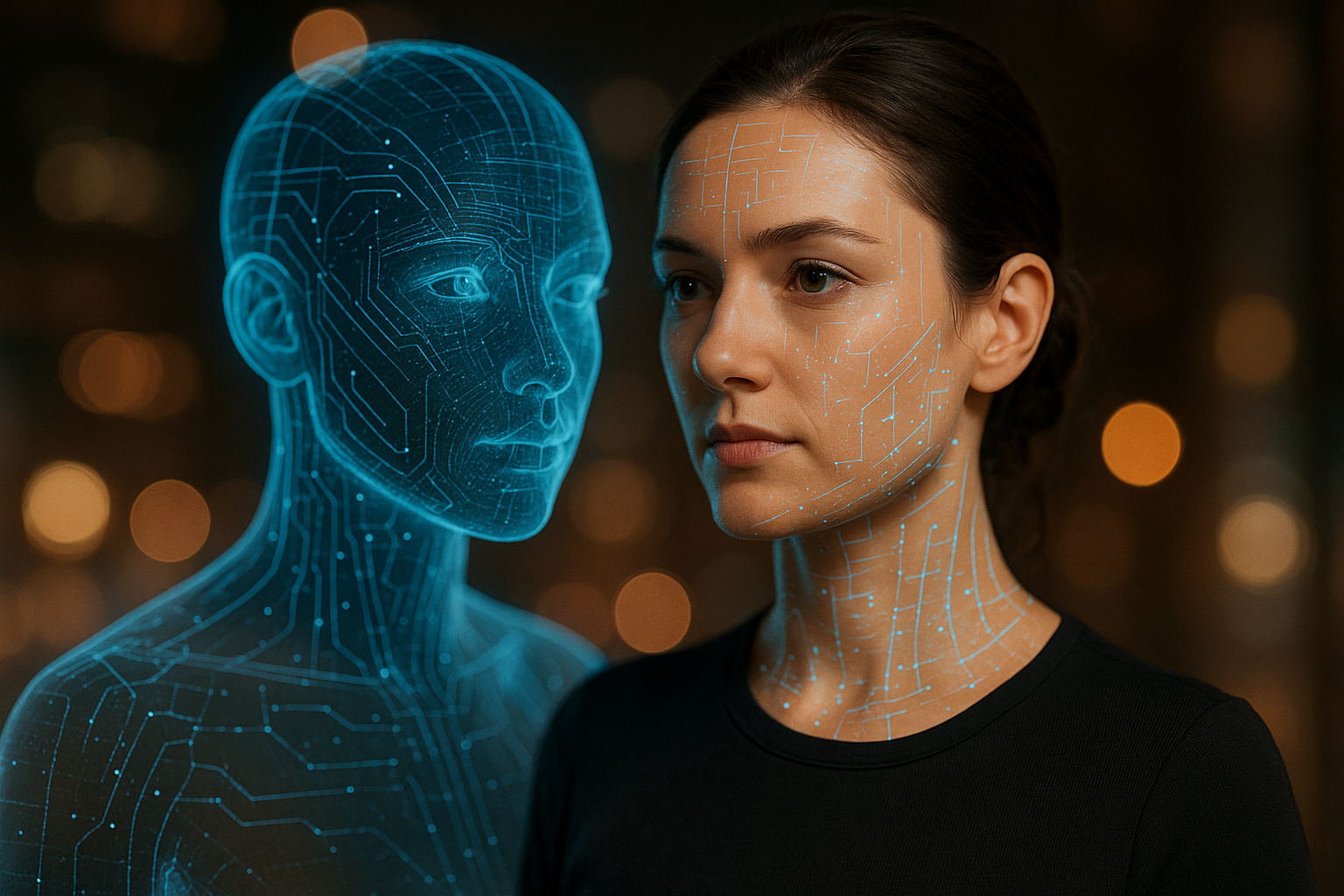
A virtual actor is an AI-generated digital performer capable of:
- delivering dialogue
- expressing emotion
- showing lifelike gestures
- interacting with environments
- appearing in any age, style, or physical form
They rely on three core technologies:
1) Neural Rendering
AI creates photorealistic faces, textures, lighting, and subtle details (wrinkles, pores, micro-expressions).
2) Motion Model Engines
AI animates body movement, posture, and emotional gestures from training data.
3) Generative Voice Systems
Fully synthetic voices or clones of real actors’ voices.
Together, they form digital humans that can perform like an actor — without ever being on set.
🟥 2. How Virtual Actors Are Created (The Hollywood Pipeline Explained)
A full digital human used to require:
- expensive 3D scanning
- volumetric capture stages
- weeks of manual animation
In 2025, this process became dramatically easier.
A) Actor Scan (Optional)
Studios may scan an actor or recreate one from existing footage.
B) Behavioral Training
AI studies the actor’s:
- smile
- blinking pattern
- body posture
- emotional timing
- micro-expressions
- speech rhythm
- pauses and breath patterns
C) AI Performance Model
A custom model learns how the actor “behaves.”
This is why AI can now generate:
- Tom Cruise running
- Emma Stone smiling
- Keanu Reeves talking stoically
- Morgan Freeman narrating
without the actor being involved.
D) Final Rendering
Neural rendering translates the model into a photorealistic digital human.
The results are shockingly realistic.
🟥 3. Why Studios Are Quietly Pivoting to Virtual Actors
Hollywood has three reasons:
Reason 1: Cost Efficiency
Producing content with real actors is expensive:
- salaries
- travel
- location shoots
- pickup reshoots
- lighting, makeup, costume
- union rules
- overtime fees
A virtual actor?
- one-time creation cost
- endless re-use
- instant reshoots
- instant de-aging
- zero scheduling conflicts
This is a producer’s fantasy.
Reason 2: Risk Control
Real actors can cause:
- scandals
- delays
- health issues
- creative disagreements
- contract disputes
Digital humans do not.
Producers call this “PR-proof casting.”
Reason 3: Creative Freedom
Virtual actors can:
- perform impossible stunts
- appear in any setting
- switch appearance instantly
- be any age
- be resurrected posthumously
This enables franchises to run indefinitely.
Hollywood loves infinite content.
🟥 4. Are Virtual Actors Replacing Humans? (The Real Answer)
Short answer:
Not entirely — but the threat is real.
Long answer:
It depends on the category of performance.
A) Leading Roles
Human actors still dominate — charisma, nuance, and subtle emotional intelligence remain unmatched.
But AI is getting closer each year.
B) Supporting Roles
This is where virtual actors are already taking jobs:
- background characters
- crowd scenes
- minor speaking roles
- reshoots for unavailable actors
Studios save millions replacing day-player and bit-part performers.
C) Digital Doubles
Stunt doubles, de-aged doubles, and continuity doubles are increasingly AI.
D) Background Extras
This category is almost completely replaceable.
Studios already use synthetic extras in:
- crowd shots
- stadium scenes
- city streets
- battle sequences
Extras are the first group being displaced.
🟥 5. The Controversial Technology: Actor Cloning
In 2025, Hollywood confronted the most explosive issue:
AI cloning real actors without permission.
Studios can now:
- replicate an actor’s face
- match their speech
- imitate their emotional style
- generate new scenes the actor never performed
This raises massive ethical issues:
- Who owns your likeness?
- Can an actor stop a studio from using their face forever?
- Can an actor be “resurrected” after death?
- Can your digital clone appear in content you never agreed to?
This is the heart of the 2024–2025 SAG-AFTRA AI negotiations.
🟥 6. Audience Reactions: Do Viewers Accept Virtual Actors?
Surprisingly, yes.
Most viewers cannot tell when:
- a background character is synthetic
- a face is partially AI-generated
- a stunt shot uses a digital double
- lighting or expression was fixed by machine learning
The line between real and artificial is already invisible.
The only time viewers care is when:
- a beloved actor is replaced
- a digital resurrection feels disrespectful
- the valley of weirdness is too noticeable (uncanny valley)
But overall, acceptance is rising rapidly.
🟥 7. The Future: What Hollywood Looks Like by 2030
Here’s the most realistic forecast:
1. Full AI Extras
Done deal. Human extras will be nearly obsolete.
2. Hybrid Acting
Real actors deliver emotional performance → AI enhances or finishes it.
3. Studio-Owned “House Actors”
Major platforms (Netflix, Disney, Max, Prime) will create proprietary AI actors exclusive to their ecosystems.
4. Long-Term Likeness Contracts
Actors will sell their digital identity for:
- reshoots
- de-aging
- background shots
- voiceover
- future sequels
5. Virtual Franchises
Studios may eventually produce full films starring:
- AI-only lead actors
- AI-only supporting cast
- AI-generated locations
- AI-generated cinematography
A complete artificial production.
🟥 Conclusion: The Industry Isn’t Ending — It’s Evolving
Virtual actors are not here to eliminate human performers.
They are here to reshape the power structure of the industry.
In the future:
- Top actors will still thrive
- New actors will need digital rights contracts
- Background work will vanish
- Hybrid films will dominate
- AI actors will become household names
The question is not:
“Will AI replace actors?”
The real question is:
“How much of an actor will still be human?”