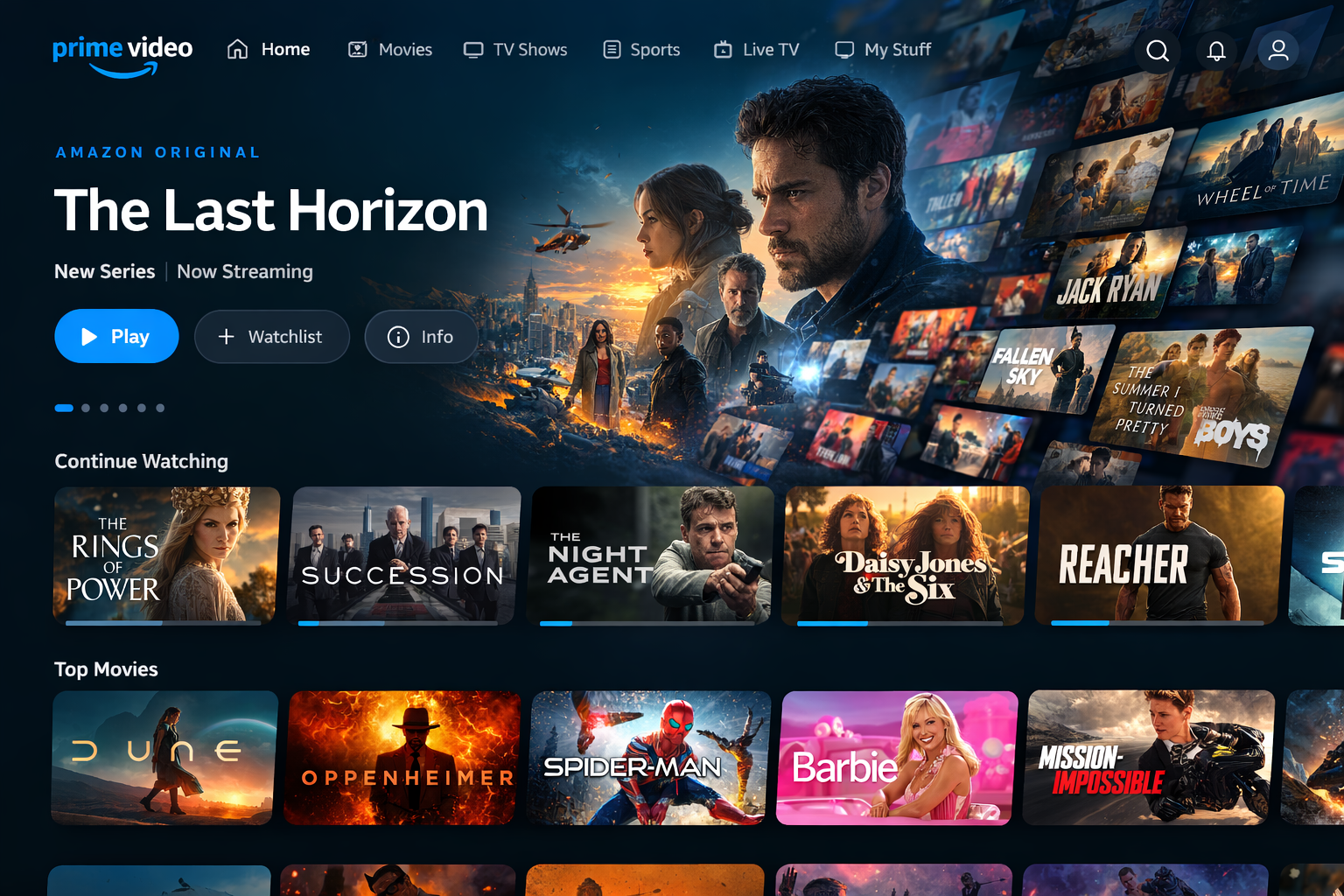
Unlike most competitors, it functions primarily as a retention layer within Amazon’s broader commerce platform.
This analysis explores whether “included” access still represents meaningful value for viewers.
This report forms part of our flagship industry analysis,
The State of Streaming 2026.
Platform Role in Amazon’s Ecosystem
Prime Video is designed to strengthen Prime membership rather than operate as a standalone profit center.
Its primary objective remains customer retention across Amazon’s retail and logistics services.
This structural advantage allows flexible pricing but complicates brand positioning.
Content Strategy: Scale Without Identity
Prime Video produces and licenses content at scale.
However, its catalog lacks consistent thematic or stylistic identity.
Blockbusters and Experiments
High-budget projects coexist with low-risk licensed content.
This creates breadth but limits long-term brand association.
Comparable content strategies appear in
Netflix’s 2026 platform analysis.
Algorithmic Curation
Discovery on Prime Video relies heavily on behavioral targeting and cross-service data.
For deeper insight, see
How AI Quietly Runs Streaming in 2026.
Monetization and Advertising
By 2026, Prime Video’s ad-supported model has become central to revenue optimization.
Ad placements are integrated across platform interfaces.
This hybrid structure blurs the boundary between subscription and commercial media.
Viewer Perception and Engagement
Many users perceive Prime Video as a secondary benefit rather than a primary destination.
Engagement spikes around flagship releases but declines rapidly afterward.
This pattern reflects broader trends identified in
The Subscription Fatigue Index 2026.
Additional behavioral context is available in
Why Viewers No Longer Stay Loyal.
Global Strategy
Prime Video continues to invest in regional originals, particularly in India, Europe, and Latin America.
Local productions serve both branding and market-entry functions.
However, most international successes remain isolated rather than scalable.
Competitive Positioning
Prime Video competes indirectly with content-first platforms by leveraging ecosystem advantages.
Disney+ and Netflix pursue more focused identity-driven strategies.
See related analyses:
Disney+ in 2026 and
Netflix in 2026.
Strategic Risks
- Weak platform identity
- Content discoverability issues
- Overreliance on ecosystem subsidies
- Advertising saturation
- Limited emotional attachment
Outlook for 2027
Prime Video is expected to remain structurally stable through 2027.
However, its competitive strength will depend on improving content identity and user experience.
Balancing commercial integration with creative credibility will be essential.
Conclusion
Prime Video in 2026 exemplifies the strengths and weaknesses of ecosystem-based streaming.
“Included” access provides scale, but not necessarily loyalty.
Long-term relevance will require clearer positioning and stronger editorial direction.
For a comprehensive industry overview, revisit
The State of Streaming 2026.