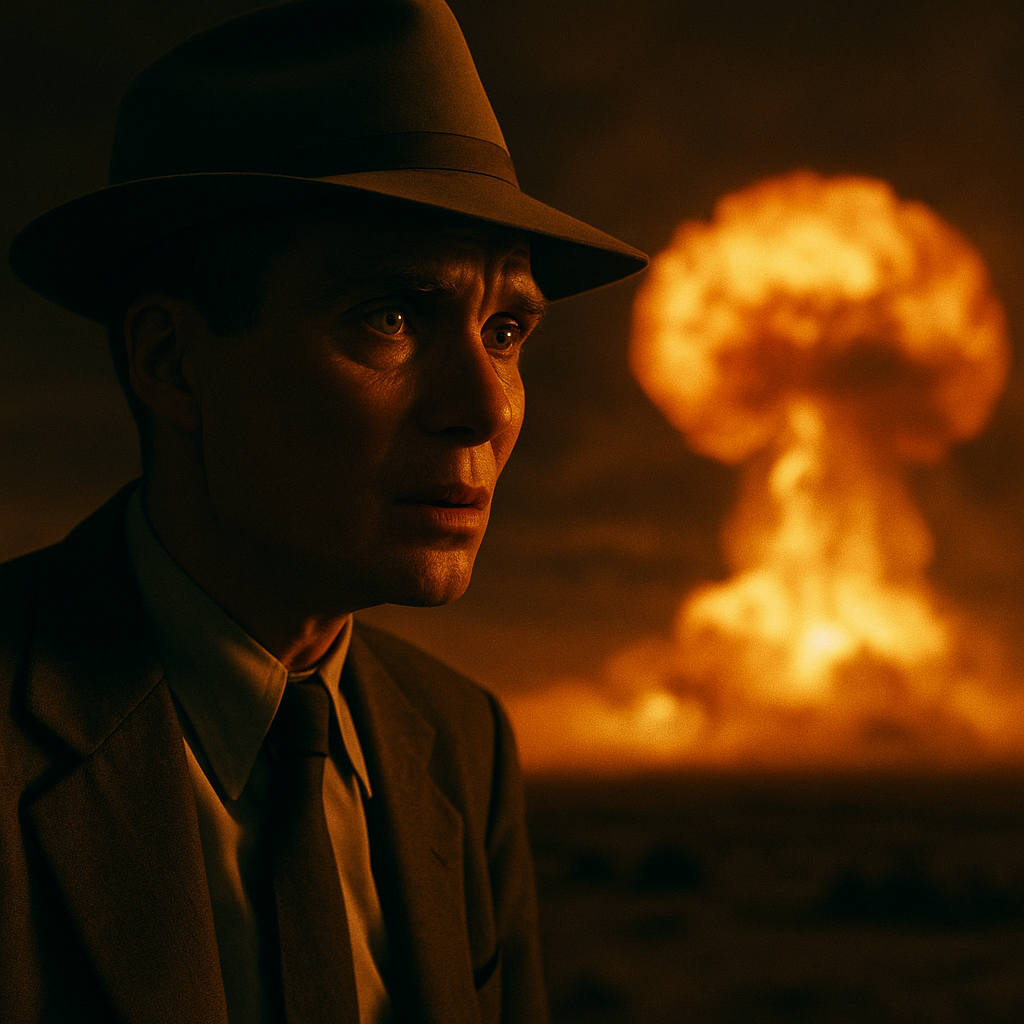
Christopher Nolan’s Trinity Test sequence is one of the most ambitious, terrifying, and technically sophisticated scenes in modern cinema.
It is not just an explosion.
It is:
- a scientific event
- a moral crisis
- a character climax
- a visual poem
- a psychological nightmare disguised as triumph
The scene is built to make the audience feel what Oppenheimer felt:
- awe
- dread
- responsibility
- guilt
- astonishment
- fear
- power
Let’s break down why this moment is so monumental.
🟥 1. The Setup: Not a Spectacle — A Countdown of Anxiety
Most films build explosions as entertainment.
Nolan builds this one as a tension bomb.
Everything leading up to the moment is designed to generate unease:
- the experimental uncertainty
- the possibility of atmospheric ignition
- the emotional collapse of Oppenheimer
- the weight of the Manhattan Project
- the moral fracture inside the team
This is not an action scene.
It is a moral crossroads.
🟥 2. Practical Effects: Nolan’s Refusal to Use CGI
Nolan famously avoided CGI for the explosion.
Instead, the Trinity Test was created using:
- gasoline detonations
- magnesium flares
- high-speed photography
- miniature pyrotechnics
- chemical reactions filmed in macro
- layered practical elements
- optical lighting techniques
This decision matters because:
Practical light behaves in ways CGI struggles to replicate.
The blast illuminates real particles.
Real shadows.
Real dust.
Real surfaces.
The authenticity amplifies the terror.
🟥 3. Cinematography: The Art of Blinding Light
Hoyte van Hoytema’s cinematography builds tension through contrast:
Before the blast:
- extreme darkness
- silence
- still camera
- faces lit by minor reflections
- compositions tight and claustrophobic
At detonation:
- pure white
- massive bloom
- slow-motion detail
- fire rolling inward
- light spilling like liquid
Nolan doesn’t show the explosion as a ball expanding.
He shows it as a living organism.
The fire behaves like consciousness.
Calm, beautiful, terrifying.
🟥 4. The Editing: Holding the Audience Hostage
The scene is edited to override viewer expectations.
Instead of:
Countdown → Explosion → Sound
Nolan delivers:
Countdown → Explosion → SILENCE
This silence after the visual blast is one of the boldest editorial decisions.
You see the fire before you hear it.
Your brain goes into panic mode because something feels wrong.
The editing replicates Oppenheimer’s subjective experience:
- time stretches
- sound disappears
- perception warps
- shock overrides logic
This is not a documentary moment.
It is a psychological POV.
🟥 5. The Sound Design: Silence as Horror
When the explosion finally hits:
- light overwhelms
- the world freezes
- and then: absolute silence
This silence:
- removes the viewer’s footing
- creates suspense
- isolates Oppenheimer
- emphasizes the magnitude
- forms a vacuum of dread
When the sound finally returns, it is:
- violent
- concussive
- overwhelming
- reality slamming back in
It feels less like an explosion
and more like the universe tearing open.
🟥 6. Cillian Murphy’s Performance: Awe Turning Into Trauma
The Trinity Test is not just an explosion.
It is the moment Oppenheimer’s identity fractures.
Murphy plays this through:
- micro-expressions
- tightening eyelids
- shallow breathing
- wide pupils
- trembling stillness
He is not celebrating.
He is witnessing the beginning of the end of the world.
Nolan isolates Oppenheimer from the cheering crowd because:
Only he understands what has truly happened.
He has given humanity the power to destroy itself.
🟥 7. Blocking: A Room Full of People, Yet Utter Loneliness
Even though dozens of scientists and soldiers surround him,
Nolan isolates Oppenheimer visually:
- shallow depth of field
- blurred figures
- lingering close-ups
- frames that cut out the crowd
He is physically present
but emotionally alone.
The explosion creates a line between him and everyone else.
The moment the bomb goes off,
Oppenheimer becomes a different kind of person:
A man who understands something the rest of humanity never should.
🟥 8. Themes: Triumph and Damnation in the Same Frame
The genius of the Trinity Test scene is that it is:
- a scientific breakthrough
- a victory for the team
- a step toward ending WWII
- a catastrophic ethical event
- a trigger for the nuclear age
Nolan blends these contradictory emotions simultaneously.
The explosion is beautiful and horrifying.
It is the great achievement and the great sin.
This duality is what makes the scene timeless.
🟥 9. The Aftermath: A Godlike Achievement with Hellish Consequences
The silence breaks.
The shockwave hits.
Dust clouds rise.
Cheering erupts.
And Oppenheimer does not cheer.
Instead, he drifts.
He sees:
- faces melting
- people burning
- skin tearing
- shadows on walls
- visions of death
These hallucinations begin here —
the psychological aftermath of the Trinity explosion.
The scene marks the moment when:
Oppenheimer realizes he has created a future he cannot control.
🟥 Conclusion: Why This Scene Is a Masterpiece
The Trinity Test scene is cinematic alchemy:
- practical effects
- psychological perspective
- breathtaking light
- suffocating silence
- crushing sound
- flawless performance
- morally charged storytelling
Nolan doesn’t show us a bomb.
He shows us:
The birth of a weapon the world was never meant to have.
It is one of cinema’s greatest scenes because it captures:
- terror
- awe
- guilt
- triumph
- history
- responsibility
…in a single blinding flash.