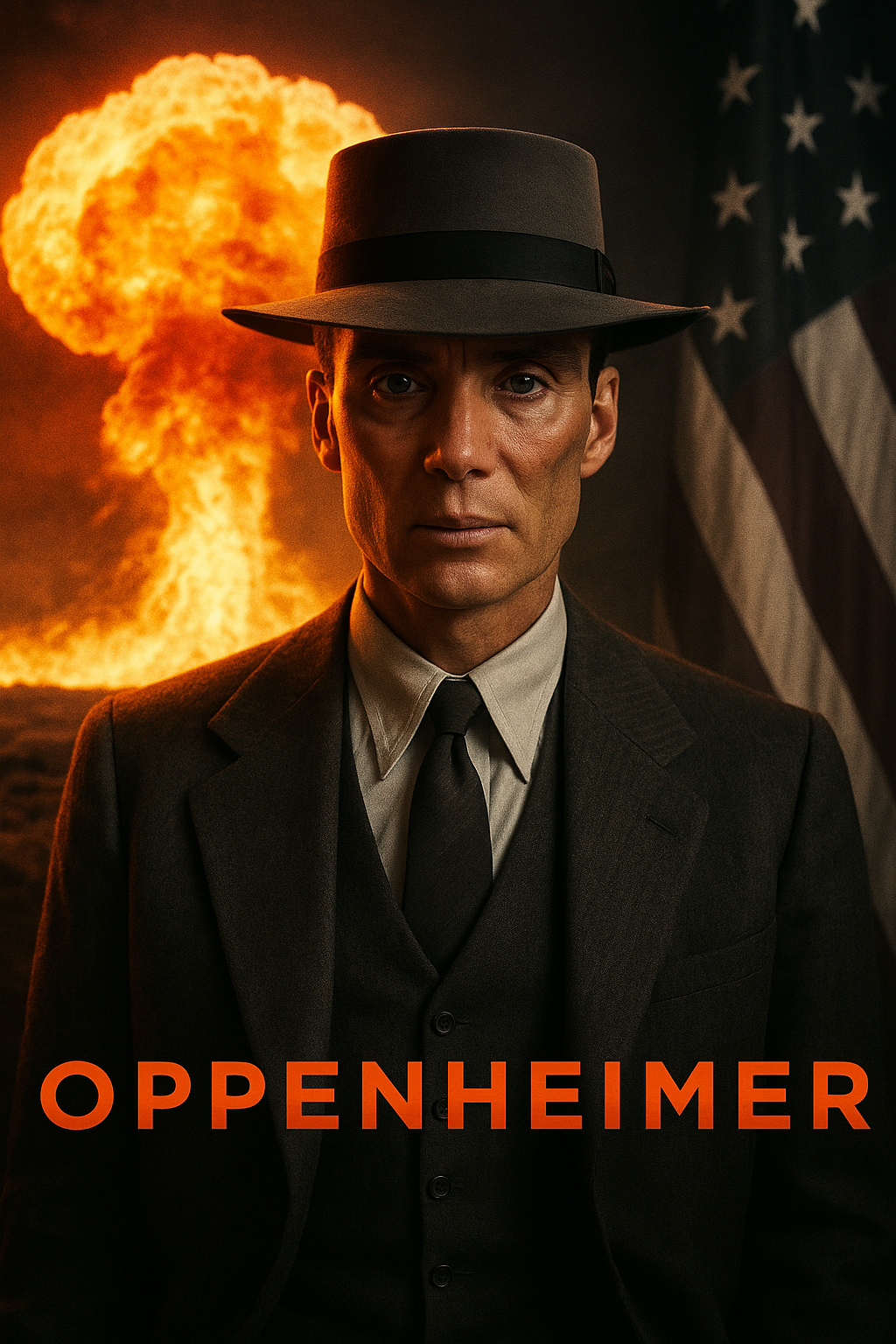
How Nolan uses “fission vs. fusion” storytelling to build his most complex narrative since Memento.
🟥 Introduction: Nolan Didn’t Just Make a Biopic — He Engineered a Narrative Machine
“Oppenheimer” isn’t a biographical drama in the traditional sense.
It is a structural puzzle, built on a scientific metaphor that shapes the entire film:
Fission and Fusion.
Two scientific processes.
Two narrative timelines.
Two conflicting perspectives.
Two versions of the same historical events.
Nolan constructs Oppenheimer’s story not around chronology, but around:
- political memory
- subjective guilt
- objective judgment
- competing narratives
- the weaponization of perspective
This analysis breaks down:
- how the dual-timeline system works
- why one timeline is in color and the other in black-and-white
- how memory vs. record shape the plot
- how Nolan manipulates time to reflect accountability
- how fission/fusion metaphors structure character arcs
- why the film’s nonlinear design is essential to its emotional punch
Let’s dissect the narrative engine behind Oppenheimer.
🟥 1. The Two Timelines: “Fission” vs “Fusion” (Nolan’s Official Terminology)
Nolan identified the timelines with scientific labels:
⭐ 1. FISSION (COLOR) — Oppenheimer’s subjective experience
- Emotional
- Internal
- Memory-driven
- Imperfect, biased, interpretive
- The world as Oppenheimer believes it happened
This is the version fueled by fragmentation — splitting events into emotional charges, like atomic fission itself.
⭐ 2. FUSION (BLACK & WHITE) — Strauss’s objective perspective
- Procedural
- Facts, hearings, depositions
- Documentary-like
- Historical record
- The world as the system sees it
Fusion is about combining elements into a singular, unified judgment — just like nuclear fusion.
This is not simply a color choice.
It is a philosophical framing device.
🟥 2. Why Color vs Black-and-White Matters (The Psychological Effect)
The dual palette isn’t aesthetic — it creates two cognitive modes:
⭐ Color = Subjectivity, Emotion, Memory
Color signifies:
- Oppenheimer’s internal experience
- his guilt
- his anxieties
- his rationalizations
- his constructed memories
The camera becomes his consciousness.
These scenes are filled with:
- shallow depth of field
- fragmented insert shots
- rapid cuts
- surreal visual moments
- hallucination-like imagery
It’s the world as he perceives it.
⭐ Black & White = Objectivity, System, Judgment
Black-and-white scenes represent:
- committees
- hearings
- investigations
- bureaucratic truth
- institutional memory
These are shot more rigidly, more still, more distant.
The world not as Oppenheimer feels it, but as the system records it.
🟥 3. The Narrators: Who Controls Each Timeline?
⭐ FISSION (COLOR)
Narrator: Oppenheimer himself
This timeline is told from:
- his memories,
- his emotional reactions,
- his psychological journey.
It is fundamentally unreliable because memory is not truth — it is interpretation.
⭐ FUSION (B&W)
Narrator: Lewis Strauss
This timeline reflects:
- political battles
- ego-driven narratives
- weaponized testimony
- historical reputation
- bureaucratic power plays
This is not subjective emotion — it is objective documentation (or the illusion of it).
This duality creates a tension:
Whose version of history survives?
🟥 4. The Structural Pattern: Two Story Arcs Moving in Opposite Directions
Nolan designs the film so each timeline moves with opposite momentum.
⭐ Fission Timeline (Oppenheimer) moves FORWARD
It starts with:
- his student years
- quantum theory
- political ideology
- Los Alamos
- Trinity Test
- Hiroshima & Nagasaki aftermath
His story builds toward the loss of control — the bomb leaves his hands.
⭐ Fusion Timeline (Strauss) moves BACKWARD
It begins with:
- Strauss’s political rise
- the Senate confirmation hearings
- testimonies
- character attacks
And as it progresses, it uncovers:
- Strauss’s insecurities
- past betrayals
- personal vendettas
- weaponization of Oppenheimer’s reputation
The timelines eventually collide at a singular point of truth.
This is narrative fusion — multiple perspectives merging into a single revelation.
🟥 5. Nolan’s Time Philosophy: Why Nonlinear Storytelling Is Essential
Oppenheimer is not nonlinear for style.
It is nonlinear because memory is nonlinear, and so is political revenge.
⭐ The Past → Shapes the Future
Oppenheimer’s political engagements from the 1930s come back to destroy him in the 1950s.
⭐ The Future → Rewrites the Past
Strauss’s hearings reinterpret earlier events, reframing Oppenheimer’s legacy.
⭐ Memory → Collides with Documentation
Oppenheimer’s emotional recollection vs. Strauss’s bureaucratic records.
⭐ Truth → Emerges from Contradiction
The dual structure lets the audience see the difference between:
- what happened
- what was remembered
- what was recorded
- what was weaponized
This makes the film less a biography and more a trial of memory itself.
🟥 6. The Trinity Test as the Narrative Fulcrum (The Point of No Return)
Trinity is the emotional center of the film.
It sits firmly in the fission timeline, because:
- the colors intensify
- the soundscape distorts
- the subjective psychological experience overwhelms
- the world feels fragmented
- time stretches unnaturally
The Trinity sequence is Oppenheimer’s moment of irreversible creation.
And from this point on:
FISSION timeline → becomes guilt-driven
FUSION timeline → becomes politically predatory
The test splits the timelines emotionally — another echo of atomic fission.
🟥 7. Oppenheimer vs Strauss: Thematic Counterpoints
⭐ Oppenheimer = The man crushed by his creation
Motifs:
- guilt
- moral uncertainty
- intellectual burden
- political naivety
- emotional fragmentation
⭐ Strauss = The man obsessed with reputation
Motifs:
- vanity
- insecurity
- political manipulation
- personal revenge
- bureaucratic power
Their timelines mirror and counterbalance each other.
They are the film’s dual protagonists — each representing a side of American power:
- creative power (Oppenheimer)
- institutional power (Strauss)
🟥 8. The Final Scene: Fusion and Fission Converge
The ending merges the timelines into a single philosophical conclusion.
Oppenheimer imagines a future where:
- chain reactions
- political escalations
- nuclear proliferation
- scientific breakthroughs
- geopolitical tensions
create a global fusion event — total annihilation.
Strauss’s version of history collapses.
Oppenheimer’s internal fears become the universal truth.
This is the ultimate narrative “fusion”:
Personal guilt + political consequence = existential reality.
🟥 Conclusion: Nolan Built a Story Where Structure Is the Message
The dual timeline structure of Oppenheimer isn’t a gimmick.
It is the film’s core meaning.
- Fission timeline → the birth of destructive power
- Fusion timeline → the consolidation of that power into politics
One is emotional.
One is institutional.
One is subjective.
One is historical.
One fractures.
One combines.
One creates.
One judges.
Together, they form a complete portrait:
The invention of the atomic age and the destruction of the man who made it possible.
This is not a movie about a man — it is a movie about how nations use men, discard them, and rewrite their legacy.
Nolan’s structure is the bomb.
And we are watching it detonate in slow motion
Related posts:
![🎬 The Social Network — Full Analysis]()
🎬 The Social Network — Full Analysis: Ambition, Betrayal & the Psychology Behind Fincher’s Masterpie...
![Home theater displaying episodic-style movie structure on a large screen]()
Why Streaming-Era Movies Feel More Like TV Seasons Than Films
![Fight Club]()
🎬 Fight Club — Why the Ending Still Works After 25 Years
![Arrival — Full Deep Analysis]()
🎬 Arrival — Full Deep Analysis: Linguistics, Nonlinear Time & The Emotional Architecture of Villeneu...