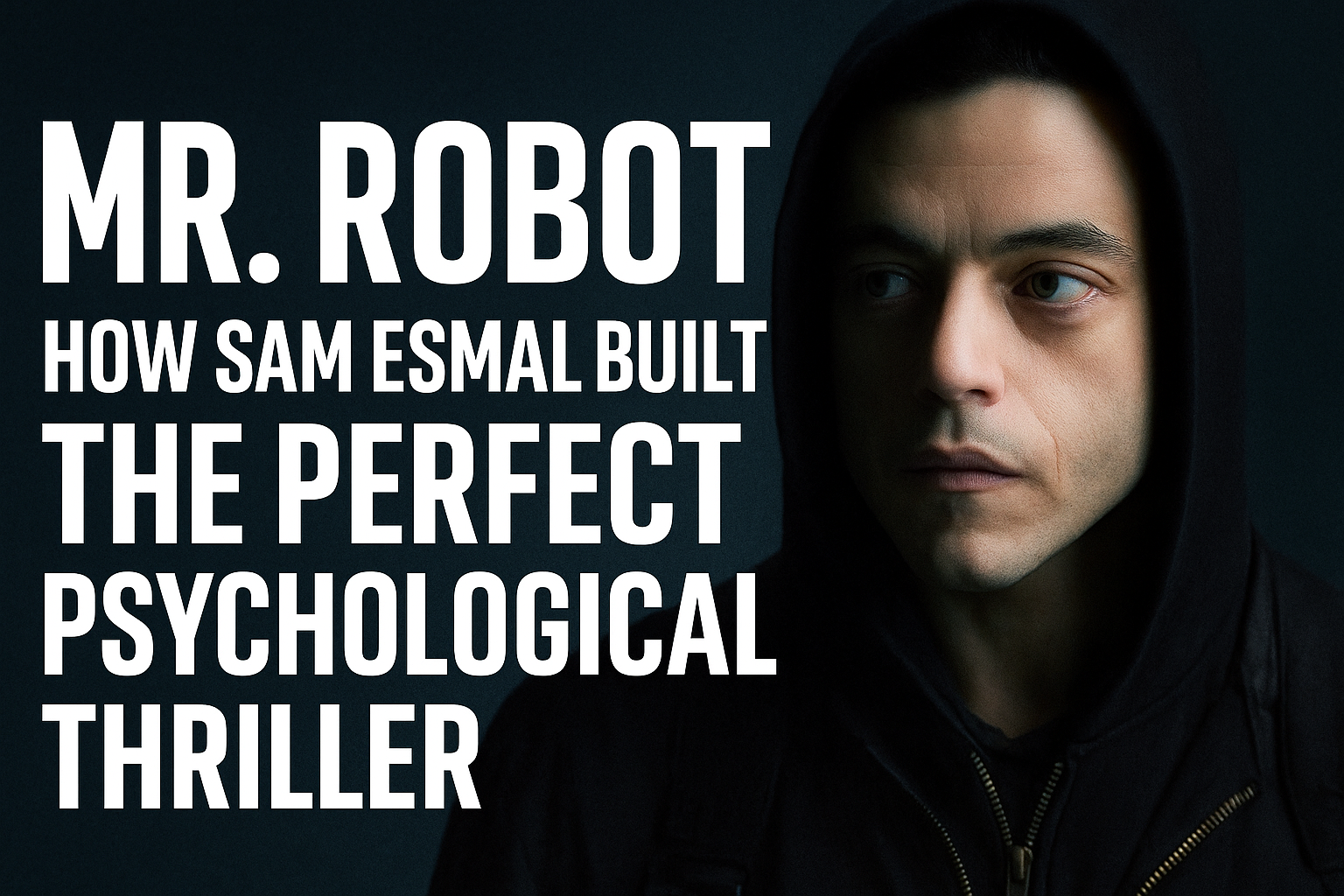
Why This Series Remains One of the Smartest TV Achievements of the 21st Century
When Mr. Robot debuted in 2015, it seemed like a sleek hacker drama.
But Sam Esmail wasn’t building a hacker show —
he was building a psychological labyrinth, a character study disguised as a thriller, a visual puzzle box where every frame communicates something hidden.
This analysis breaks down how Esmail constructed one of the most meticulously engineered psychological thrillers ever made.
🟦 1. The Unreliable Narrator as the Entire Engine
“Hello, friend.”
Most shows use the unreliable narrator as a twist.
Esmail uses it as the foundation.
Elliot Alderson is:
- socially detached
- mentally fragmented
- traumatized
- unreliable by design
- unable to differentiate memory from delusion
Thus, the story itself becomes unstable.
Elliot isn’t lying —
his reality is broken.
And that gives the show a narrative tension no conventional thriller can match.
🟦 2. Visual Language Designed to Make You Uneasy
Mr. Robot’s framing is iconic:
- extreme headroom
- characters pushed to the edges of the frame
- empty negative space
- off-center compositions
- oppressive architecture
These choices are not aesthetic—they’re psychological.
The viewer feels Elliot’s alienation.
Every shot says:
“You are not supposed to feel comfortable.”
This visual grammar is one of the most distinctive in modern TV.
🟦 3. Sound Design as Internal Dialogue
Mr. Robot is one of the rare shows where:
- silence
- distortion
- ambient hum
- fragmented audio
…all function as extensions of Elliot’s mind.
The soundtrack and sound design don’t accompany the story —
they narrate his mental state:
- paranoia → high-frequency tones
- dissociation → muffled ambience
- control → clean, sharp mix
- collapse → chaotic audio layering
This creates a uniquely immersive psychological experience.
🟦 4. The Show Treats Hacking as Metaphor, Not Spectacle
Unlike Hollywood-style hacking shows, Esmail avoids:
- flashy UI animations
- unrealistic typing montages
- magical instant access
Instead, hacking is portrayed as:
- methodical
- slow
- lonely
- logical
- obsessive
It becomes a metaphor for:
- control
- identity
- rebellion
- Elliot’s desire to rewrite the world
- Elliot’s desire to rewrite himself
This realism elevates the show far beyond the genre.
🟦 5. The Psychological Core: Trauma, Identity, Fragmentation
Elliot’s journey isn’t really about taking down E Corp.
It’s about:
- the truth he’s hiding from himself
- the personality fractures he can’t face
- his suppressed anger
- his unresolved grief
- the parts of him he exiled
Each season peels another layer off his mind.
Sam Esmail structures the entire narrative like trauma therapy:
Season 1 — Denial
Season 2 — Confusion
Season 3 — Confrontation
Season 4 — Integration
It’s one of the most accurate portrayals of psychological healing in TV.
🟦 6. Mr. Robot (the character) as a Manifested Coping Mechanism
Mr. Robot is not a twist villain.
He is Elliot’s rage, authority, protection, and pain manifest in human form.
He represents:
- Elliot’s survival instinct
- Elliot’s suppressed trauma
- Elliot’s desire for control
- Elliot’s inner revolution
The relationship between Elliot and Mr. Robot is not good vs. evil —
it’s fragment vs. self.
🟦 7. Cinematic Direction That Never Breaks Tone
Esmail brings:
- long takes
- symmetrical compositions
- Kubrickian tension
- Fincher-style coldness
- noir lighting
- surreal dream imagery
But unlike many directors, he never breaks his own grammar.
From Episode 1 to the finale, the visual identity remains consistent.
That’s why the show feels like a four-season film.
🟦 8. Thematic Spine: Capitalism, Loneliness, Power, and the Lie of “Control”
Mr. Robot is not just psychological.
It’s political — but not in a cheap or didactic way.
Its core themes:
- systems that exploit individuals
- the illusion of individual agency
- tech-enabled isolation
- corporate power vs. human vulnerability
- the human cost of survival
The show argues we don’t live in a society built for mental health —
and Elliot’s collapse is proof.
🟦 9. One of the Greatest Finales in TV History
The ending of Mr. Robot does something nearly impossible:
- resolves the psychological mystery
- honors every theme
- reveals the emotional truth
- recontextualizes the entire narrative
- feels earned, not forced
The final revelation isn’t a twist —
it’s catharsis.
It turns the entire show into a story about:
- grief
- identity
- trauma integration
- self-acceptance
It’s one of the rare finales that makes the whole series better.
🟥 Conclusion: Why Mr. Robot Is a Perfect Psychological Thriller
Sam Esmail built a show that is:
- visually unique
- psychologically layered
- narratively risky
- thematically bold
- emotionally devastating
- technically masterful
Mr. Robot isn’t just a thriller.
It’s a character’s mind turned into cinema.
And that’s why it remains one of the greatest psychological achievements in television history.
This idea connects closely with our analysis on narrative pacing and viewer loyalty.