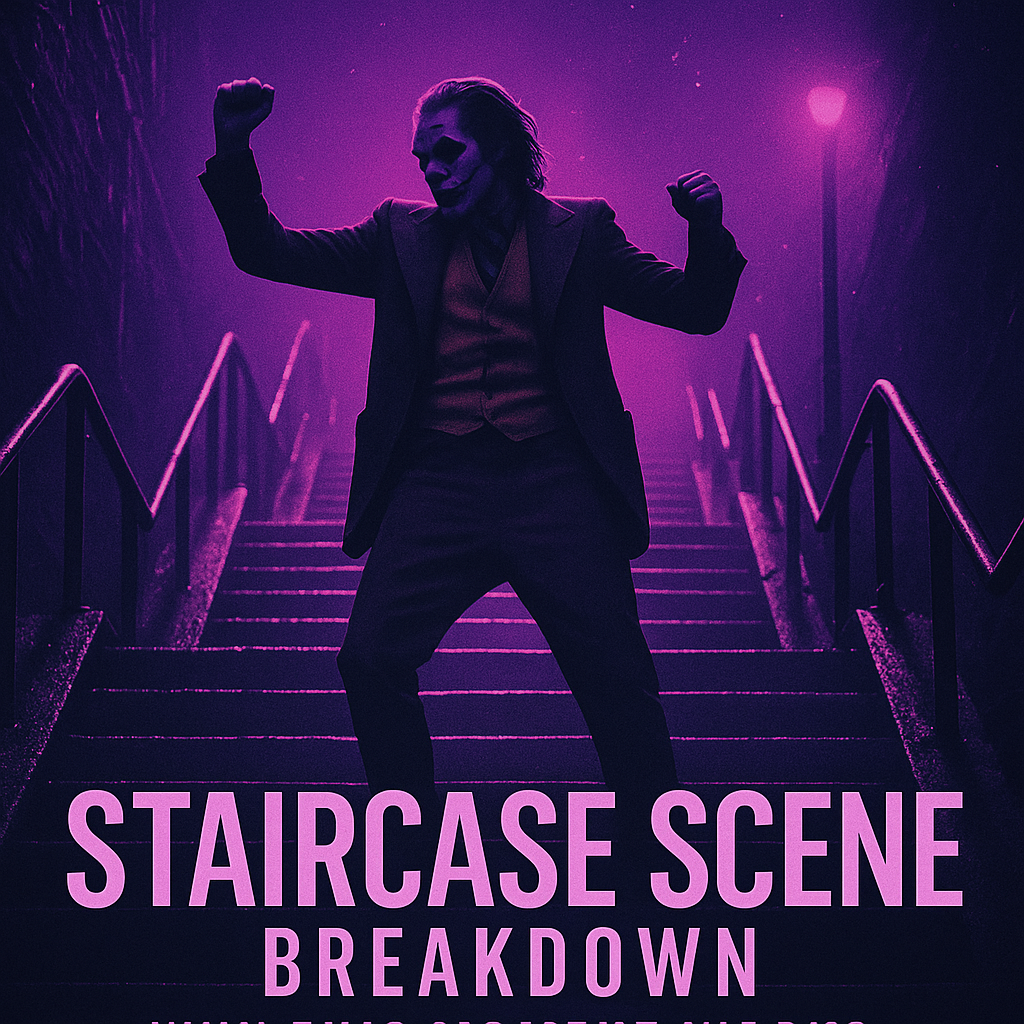
The Joker staircase scene is one of the most iconic cinematic moments of the 21st century.
It arrives late in the film, lasts barely two minutes, and yet has become its defining image — a moment of transformation, liberation, and terrifying clarity.
But why does it work so well?
Why does Arthur Fleck dancing on a concrete staircase feel like the emotional peak of the story?
Here’s the breakdown.
1. The Staircase as a Symbol: From Burden to Freedom
For most of the film, the staircase is a punishing obstacle.
Arthur climbs it every day:
- exhausted
- depressed
- beaten down by the world
- carrying the weight of poverty
- dragging his fragile identity behind him
It represents his life:
a slow, painful climb toward nothing.
✔ In the first half:
Arthur ascends the staircase → exhausted, drained.
✔ In the transformation:
Joker descends the staircase → liberated, energized.
This is the core symbolism:
Arthur climbs because he is crushed.
Joker dances because he is free.
2. The Music Shift: “Rock and Roll Part 2” as an Anthem of Rebirth
The soundtrack choice is shocking and intentional.
Gary Glitter’s “Rock and Roll Part 2” is:
- upbeat
- aggressive
- stadium-like
- celebratory
It should not fit… but that’s the point.
It isn’t “Arthur’s music.”
It’s Joker’s music.
Arthur’s score throughout the film is:
- cello
- heavy
- suffocating
- slow
Joker’s arrival replaces sorrow with confidence and chaos.
The music tells us Joker has taken control.
3. Costume and Body Language: Full Arrival of the Persona
Arthur’s evolution is visible in three key ways:
1. The Suit
Bright, bold colors replacing muted sadness.
2. The Hair
Styled back — controlled, intentional.
3. The Dance
Loose, theatrical, expressive, confident.
Joker moves like a man who finally recognizes himself.
The costume is not a disguise.
It is Arthur’s true form.
4. The Cinematic Contrast: Light vs Darkness
The movie uses color to show Arthur’s descent and Joker’s rise:
- Arthur’s world is gray, cold, oppressive
- Joker’s colors are vibrant, explosive, dangerous
On the staircase:
- Bright sunlight
- Vivid costume
- Wild movement
This is visual liberation.
The world that once suppressed him is now his stage.
5. The Camera Movement: Chaos Turned Into Dance
The cinematography reinforces the transformation:
- The camera is wide → Joker “owns” the space
- Movements are loose → not stiff like Arthur
- Angles are low → Joker seems powerful
- The cuts follow rhythm → chaos becomes choreography
Arthur was filmed tightly, often with boxed-in close-ups to show anxiety.
Joker is filmed with room, like a performer.
He is no longer a man trapped by society —
he is the director of his own scene.
6. The Police Arrival: Reality Crashes Back In
As Joker dances, the music drops suddenly.
Two detectives appear at the top of the staircase.
This is intentional:
- Joker’s moment of freedom is challenged
- Society is still coming for him
- The fantasy collides with consequences
But the scene proves Joker is now too far gone to be stopped.
He runs.
He laughs.
He embraces the chaos.
This is not Arthur escaping trouble.
This is Joker inviting it.
7. Why the Scene Feels So Disturbingly Satisfying
Because it is earned.
We’ve watched Arthur break piece by piece:
- bullied
- ignored
- misunderstood
- mistreated
- exploited
- lied to
- abandoned
This moment is not random.
It is the explosive release of everything building inside him.
The dance is disturbing because:
- We understand why he feels free
- We know this freedom comes from violence
- We feel the seduction of release
- We fear what this liberation means for others
It taps into the uncomfortable truth:
Humans understand the desire to escape suffering — even the dark forms it takes.
8. The Larger Message: Transformation Through Madness
The staircase scene is the moment when:
- Arthur dies
- Joker is born
It’s not a villain’s celebration.
It’s a man finally feeling alive.
The tragedy is that:
- He finds joy only through destruction
- He finds identity only through chaos
- He finds freedom only by abandoning morality
It’s a rebirth —
but a monstrous one.
⭐ Final Interpretation: Why It Works
The scene works because it merges:
- Symbolism
- Music
- Cinematography
- Performance
- Storytelling
- Emotional catharsis
- Psychological rupture
It is the perfect moment where narrative and image fuse into meaning.
It is the moment Arthur becomes an idea —
and ideas cannot be killed.
Related posts:
![Inception — Hallway Rotating Fight Scene Breakdown]()
🎬 Inception — Hallway Rotating Fight Scene Breakdown:
![Breaking Bad]()
🎬 Breaking Bad — “I Am The One Who Knocks” Scene Breakdown: Walter White’s Darkest Turning Point
![The Dark Knight — Interrogation Scene Breakdown]()
🎬 The Dark Knight — Interrogation Scene Breakdown: A Masterclass in Psychological Power
![Interstellar — Docking Scene Breakdown]()
🎬 Interstellar — Docking Scene Breakdown: The Art of Controlled Chaos