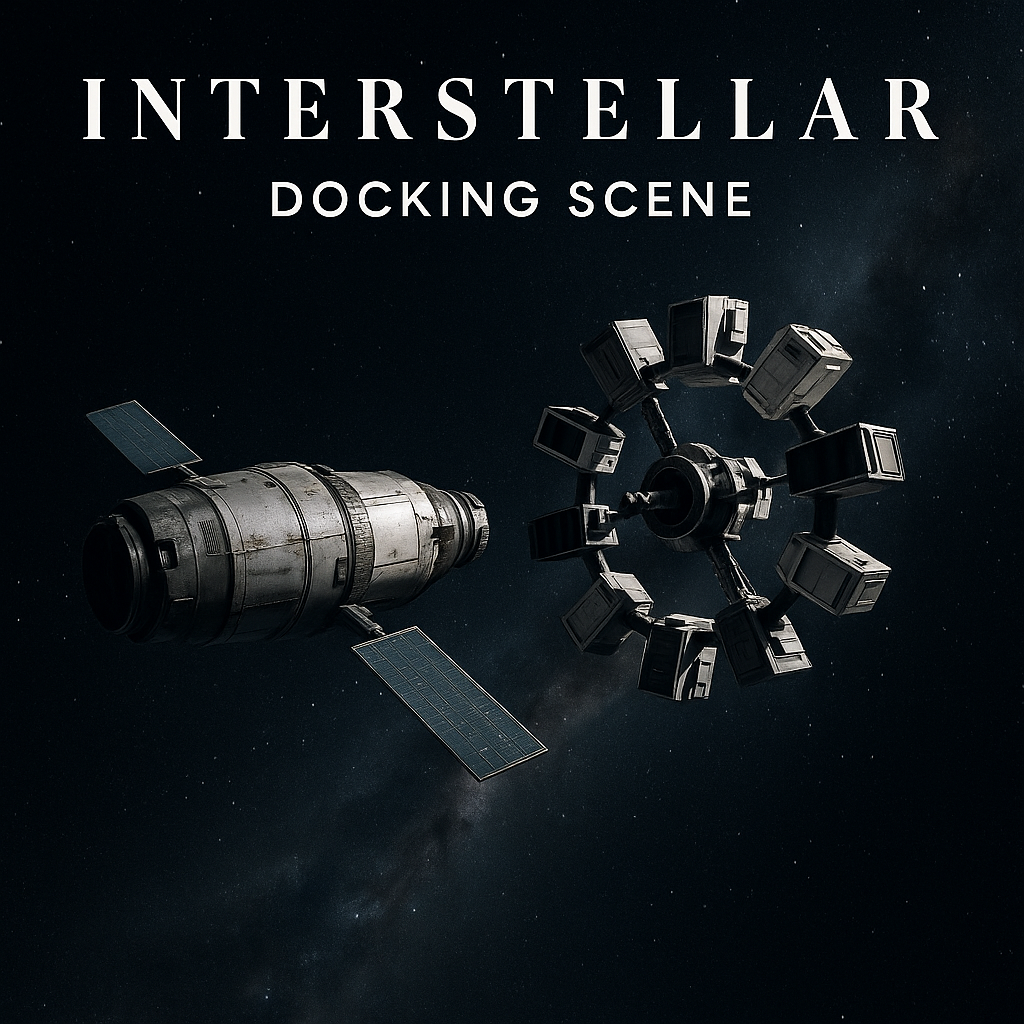
Few scenes in modern sci-fi generate the level of white-knuckle tension as the docking sequence in Interstellar.
It’s a perfect collision of:
- physics
- emotion
- music
- editing
- performance
- cinematography
…and the terrifying idea of fighting physics itself to survive.
This is not just a visual spectacle.
It is a mathematical problem executed at the edge of human capability — portrayed with surgical cinematic precision.
Let’s break down exactly why this scene hits so hard.
🟥 1. The Setup: A Scene Built on Consequence
Dr. Mann’s betrayal destroys the Endurance’s docking port, sending the station into a violent spin.
Without docking:
- the crew cannot stabilize orbit
- they cannot complete the mission
- they will drift into planetary gravity
- they will die
Everything collapses in seconds.
This isn’t a “cool action moment.”
It’s a life-or-death physics puzzle.
🟥 2. The Visual Language: Motion as the Villain
Most action scenes use an antagonist.
Nolan uses angular momentum.
The enemy is rotational velocity —
something that cannot be intimidated, negotiated with, or slowed.
The Endurance:
- spins
- shakes
- vibrates
- shudders
- rotates out of alignment
Cooper must:
- match rotation
- match speed
- match axis
- match alignment
- dock perfectly
This creates a visual war between order and chaos.
🟥 3. Cinematography: IMAX As a Tension Device
The scene uses:
- IMAX close-ups of McConaughey
- wide shots of the spinning Endurance
- cockpit POVs
- gyroscopic motion
- minimal CGI (practical miniatures dominate)
The scale shifts constantly:
- micro (dials, switches, shaking hands)
- macro (the spinning station in space)
This creates a sense of overwhelming risk.
You feel small watching it — exactly as intended.
🟥 4. The Sound: Hans Zimmer’s Organ as a Survival Pulse
Zimmer’s score is the heartbeat of the scene.
Elements:
- organ blasts
- mechanical ticking
- rising harmonics
- pulsing tempo
- dissonant chord pressure
Zimmer intentionally mirrors:
- the spinning motion
- the rising stakes
- Cooper’s adrenaline
- Murph’s timeline
- gravitational tension
The music does not beautify the scene.
It crushes the audience with pressure.
🟥 5. Editing Rhythm: Speed vs Stillness
Nolan alternates between:
Fast Cuts
- cockpit chaos
- spinning debris
- rotating alignment indicators
- hands slamming controls
Slow Push-Ins
- Cooper’s determination
- Brand’s terror
- the rotating lock mechanism
This push-pull rhythm creates maximum tension:
- fast gives the danger
- slow gives the fear
The pace accelerates until the very last second.
🟥 6. Performance: Cooper’s Brilliance Delivered Quietly
McConaughey doesn’t scream.
He doesn’t panic.
He doesn’t monologue.
He focuses.
This is a key choice:
Cooper survives not because he is emotional
but because he is skilled.
His pilot instincts take over:
- micro-correcting thrusters
- reading rotational vectors
- controlling centrifugal drift
- timing acceleration bursts
- trusting physics over panic
This calm intensity elevates the scene from action to mastery.
🟥 7. Brand’s Role: The Emotional Counterweight
Anne Hathaway’s Brand represents the human cost.
Her panic and tears are not weakness —
they are realism.
She knows:
- Cooper is attempting something nearly impossible
- one error ends everything
- she is powerless to help
Brand becomes the avatar for audience emotion.
Cooper becomes the avatar for audience hope.
🟥 8. The Line That Defines the Scene
The entire sequence crystallizes in a single line:
“It’s not possible.”
“No. It’s necessary.”
This is the thematic core.
Interstellar isn’t about comfort.
It’s about responsibility.
Not acting = death.
Trying = survival.
Necessity overrides possibility.
This is why the audience feels the weight of Cooper’s decision.
🟥 9. The Docking Itself: A Ballet of Precision
When Cooper matches rotation:
- rotation syncs
- axis aligns
- wobble stabilizes
- vibration lowers
- magnetics begin to lock
The camera circles with the rotation,
signaling that Cooper has achieved lock-step motion.
For a moment, the impossible becomes stable.
This is Nolan’s visual metaphor:
Mastery turns chaos into order.
🟥 10. The Aftermath: Silence as Release
Once the docking succeeds:
- the music stops
- Brand gasps
- Cooper exhales
- the room stills
Nolan uses silence as catharsis.
All the pressure built over minutes collapses at once.
Your body feels it.
This is how you create a scene that lives in cinema history.
🟥 Conclusion: A Scene That Redefined Sci-Fi Tension
The Interstellar docking sequence is not memorable because of spectacle.
It’s memorable because it combines:
- real physics
- emotional stakes
- human mastery
- stunning audiovisual design
This is Nolan at his finest:
using science to create drama
and using cinema to make science feel mythic.
The docking sequence is not just “great sci-fi.”
It’s one of the most perfectly engineered scenes ever filmed.