The Moment Nolan Bent Reality Without Breaking Logic
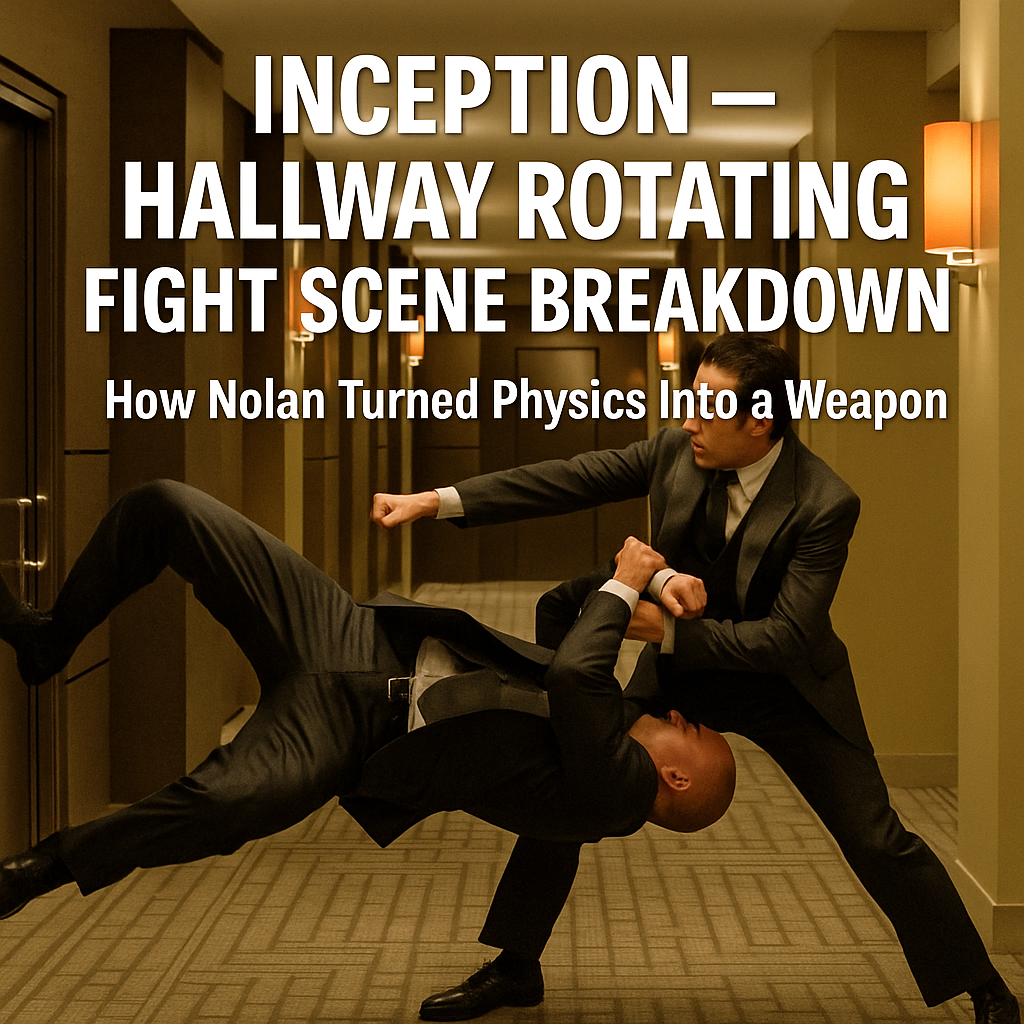
Christopher Nolan’s rotating hallway fight is one of the most mind-bending action scenes ever filmed.
It’s not just a fight scene — it’s a demonstration of:
- physics as violence
- gravity as choreography
- architecture as a moving character
- time layered inside dreams
- action built on mathematics, not spectacle
While every blockbuster around it leaned on digital shortcuts, Nolan chose the opposite:
He built a hallway.
He made it rotate.
And he put Joseph Gordon-Levitt inside it.
Let’s break down how this insane moment was engineered.
🟥 1. The Setup: A Fight Inside a World With Collapsing Rules
The hallway scene happens during a dream level where:
- gravity destabilizes
- the environment loses its orientation
- “up” becomes meaningless
Normally, action scenes rely on stable physics.
Here, Nolan removes the anchor.
This is not just a fight for survival.
It’s a fight against the environment itself.
Nolan weaponizes gravity.
🟥 2. The Practical Rotating Set: Engineering the Impossible
The rotating hallway wasn’t CGI — it was built as a 100-foot-long cylindrical corridor mounted on a giant gimbal.
Key engineering details:
- the entire set rotates 360°
- rigged motors slowly push the hallway
- the actors and stunt team must react in real time
- lighting is embedded directly into the moving walls
- everything is timed to millisecond precision
Why does this matter?
Because every impact is real.
When a character slams into the ceiling — it’s an actual ceiling.
When the hallway tilts — the actor is actually falling sideways.
The physical authenticity creates visceral discomfort the audience can feel.
🟥 3. Cinematography: Shooting in a World Without Up or Down
Hoyte van Hoytema uses the camera as a stabilizer — and a disorienter.
Two visual techniques define the scene:
1. Locked-off Camera Rotation
The camera is mounted to the hallway, so it rotates with the environment.
This makes gravity feel like it’s shifting in unpredictable ways.
2. Free Camera Floating
At moments, the camera detaches and floats independently, heightening chaos.
The result:
The viewer constantly questions their own center of balance.
Nolan turns the camera into a participant.
🟥 4. Choreography: Fighting as the World Spins
Because the hallway physically rotates:
- punches become horizontal
- falls become vertical
- kicks become diagonal
- footing becomes unreliable
The fight choreography relies on:
- muscle memory
- timing
- precise center-of-mass control
- weight distribution prediction
There is no “cool martial arts moment.”
The choreography is about survival, not style.
This is what makes it brilliant.
🟥 5. Editing: Long Takes Instead of Rapid Cuts
Unlike modern action scenes that rely on fast cutting to hide imperfections, Nolan does the opposite.
He holds the shots.
Long takes show:
- real continuous rotation
- real physics
- real bodies hitting surfaces
- real spatial geography
The editing respects the space.
Because the space is the star.
Every cut is purposeful — it maintains the viewer’s sense of dread and physical tension.
🟥 6. Sound Design: Weight, Metal, and Human Impact
While the visuals rotate wildly, the sound grounds the viewer.
The scene uses:
- deep metal groans (set rotation)
- thumps of bodies hitting surfaces
- rubber soles slipping
- low, muffled dream-state ambience
There is no heroic music here.
Nolan chooses discomfort.
You hear the hallway struggling against its own motion.
You hear gravity fail.
Sound becomes a pressure chamber.
🟥 7. Joseph Gordon-Levitt’s Performance: Precision Over Flash
This is not stunt double territory — Gordon-Levitt performed over 90% of the sequence himself.
His acting is defined by:
- micro-balance adjustments
- controlled panic
- “bracing” posture
- realistic exhaustion
He is not a superhero.
He is a man fighting physics.
Every slip, every scramble, every desperate grab is built on genuine effort.
He sells the danger.
🟥 8. Themes: Physics as Dream Logic
Nolan uses the hallway fight to visualize:
- collapsing dream layers
- unstable reality
- subconscious physics
- time distortion
The hallway rotates because the dream above it is tumbling inside a van.
Dream logic is expressed through physical motion.
It’s not magical.
It’s mathematical.
This is why the scene stands out in a film already full of iconic moments.
🟥 9. Why This Scene Still Dominates Action Cinema
The rotating hallway remains iconic because it is:
- practical
- tangible
- scientifically grounded
- visually fresh
- physically terrifying
- choreographically innovative
- narratively meaningful
Most films simulate physics.
Nolan weaponizes physics.
He makes the environment the antagonist.
And he lets the audience feel every brutal second.
🟥 Conclusion: A Masterclass in Physics-Driven Action
The hallway scene is more than a technical marvel.
It’s a lesson in:
- engineering
- cinematography
- physical acting
- practical effects
- spatial storytelling
This scene proves that action does not need CGI, superpowers, or hyper-editing.
It needs rules, and then the courage to break them.
Nolan created a fight scene that feels impossible —
because it was almost impossible to film.
A rotating nightmare.
A physics puzzle.
A cinematic milestone.
Related posts:
![Oppenheimer — Trinity Test Scene Breakdown]()
🎬 Oppenheimer — Trinity Test Scene Breakdown: The Anatomy of Controlled Fear
![Editor reviewing a dramatic television scene on a professional monitor]()
How One Scene Can Define an Entire Series: A Breakdown of Modern TV Storytelling
![Joker Staircase Scene Breakdown]()
Joker Staircase Scene Breakdown: Why This Moment Works
![Breaking Bad]()
🎬 Breaking Bad — “I Am The One Who Knocks” Scene Breakdown: Walter White’s Darkest Turning Point