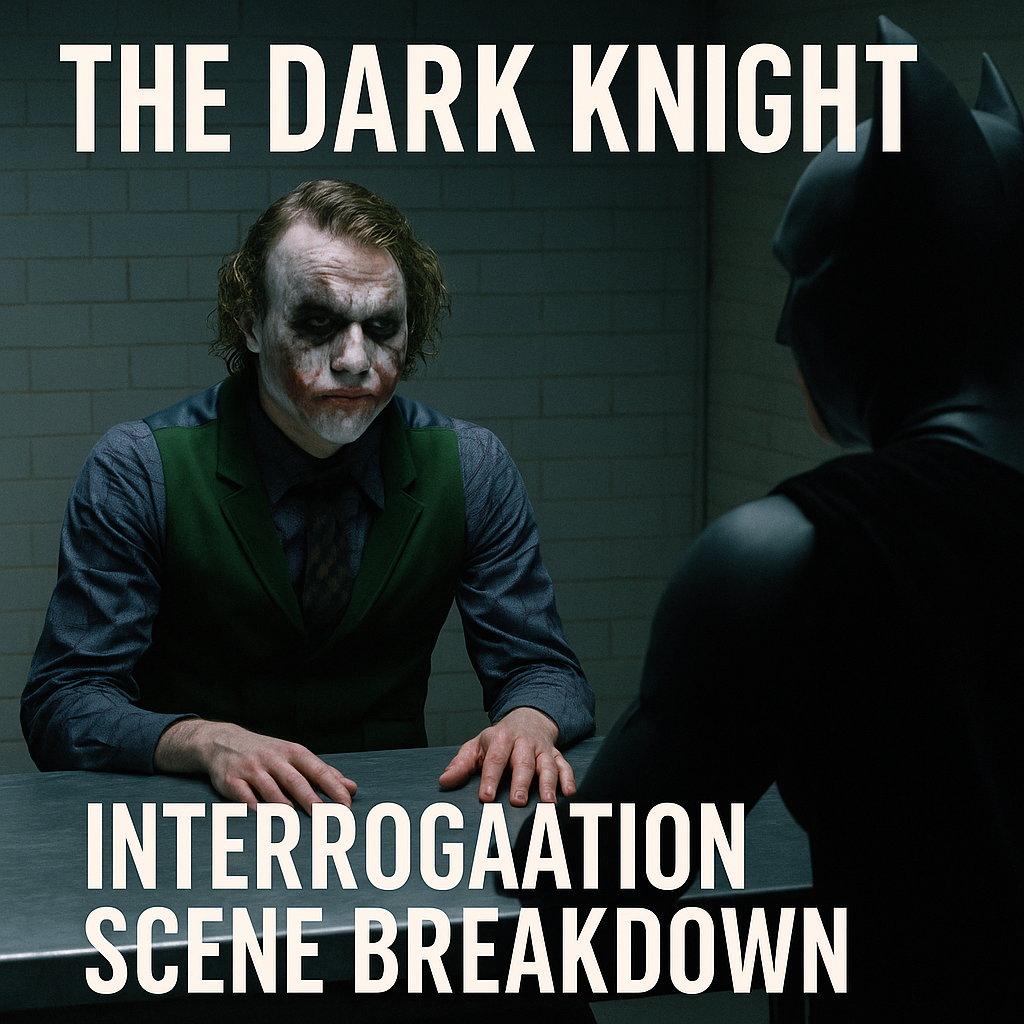
Few scenes in modern cinema have achieved the mythic status of the interrogation room confrontation between Batman and the Joker in The Dark Knight.
It’s not a fight scene.
It’s not an action sequence.
It’s not even about information.
It is pure psychological warfare, orchestrated with surgical precision by Christopher Nolan, powered by legendary performances from Heath Ledger and Christian Bale, and built on a cinematic language designed to trap the audience exactly where the characters are — in a room where control shifts second by second.
This breakdown dives into:
- camera placement
- lighting
- pacing
- performance choices
- blocking
- editing rhythm
- thematic underpinnings
- why this scene remains iconic
Let’s break it down.
🟥 1. The Setup: A Room Designed for Power Reversal
The interrogation room is intentionally simple:
- bare walls
- cold lighting
- no windows
- no music
- steel table
- two chairs
- a single overhead lamp
This minimalism is not realism — it’s strategic.
Nolan strips away distractions so the power dynamic becomes the entire visual focus.
The room is a trap, but not for the Joker — it’s for Batman.
The Joker wanted to be here.
Batman didn’t realize it until it was too late.
🟥 2. The First Shot: Joker in Total Control
The iconic opening shot:
- Joker sits alone
- motionless
- waiting
- his back to the camera
- soft overhead light
- silence
This isn’t a criminal in fear.
He looks like a man waiting for a dinner reservation.
He is relaxed, unshaken, almost meditative.
Nolan deliberately frames Joker small in the room to show he doesn’t need physical presence — he controls the space through chaos.
🟥 3. The Entrance: Batman’s Power Is Physical, Joker’s Power Is Psychological
When Batman enters:
- lights slam on
- the room is flooded with harsh white fluorescence
- Batman stands behind Joker
- Joker doesn’t flinch
This is the moment the audience understands:
Batman’s tools don’t work on the Joker.
Shock?
Surprise?
Fear tactics?
Intimidation?
All useless.
Ledger’s micro-reaction is iconic:
a single, subtle smile — not fear, but delight.
🟥 4. Blocking and Camera Strategy: The Tables Turn — Literally
The early framing places:
- Batman standing
- Joker seated
- table as barrier
- power clearly with Batman
But midway through the scene, Nolan slowly shifts:
- Joker leans forward
- Batman sits
- camera lowers
- Joker begins filling the frame
The power dynamic flips.
By the midpoint:
Joker becomes the dominant figure despite never standing up.
That’s psychological blocking.
🟥 5. Performance Dynamics: Ledger Dictates the Rhythm
Ledger plays the Joker like a conductor:
- pauses
- breath control
- soft speech
- sudden pitch drops
- unpredictable pacing
- unsettling laughter
- direct eye contact
- disarming honesty
Bale plays Batman rigid, tense, reactive.
This contrast is intentional:
Joker → fluid chaos
Batman → structured control
But structure collapses when chaos enters.
🟥 6. The Turning Point: Joker Reveals the Trap
The line that flips the entire scene:
“You have nothing… nothing to threaten me with.”
This is the moment Batman loses.
He can:
- hit him
- break him
- throw him
- scream
But Joker doesn’t care about pain.
Pain is currency to him.
The more Batman loses control,
the more Joker wins.
🟥 7. Violence as Joker’s Weapon — Not Batman’s
When Batman snaps and attacks:
- slamming Joker
- punching him repeatedly
- dragging him into the wall
Everything flips.
Physical violence increases Joker’s power.
Because the Joker’s goal isn’t survival.
It’s corruption.
Every punch Batman throws:
- proves Joker’s point
- further traps him in Joker’s rules
- erodes Batman’s moral superiority
Joker wants Batman to break his one rule.
And this is the closest we ever see him to crossing it.
🟥 8. Editing: Chaos Cuts vs Control Cuts
The editing style shifts with the emotional wave:
Early Scene Editing
- slower cuts
- symmetrical composition
- balanced shot duration
- calculated pacing
Mid-to-Late Scene Editing
- rapid cuts
- tighter frames
- claustrophobic push-ins
- handheld motion
- increased urgency
The editing becomes Batman’s panic.
🟥 9. Sound Design: Silence as a Weapon
There is no music.
This is one of the boldest choices.
Silence becomes:
- pressure
- tension
- psychological claustrophobia
We hear:
- Joker’s breathing
- chair scraping
- fabric rustling
- punches landing
- Joker laughing
The lack of score forces the audience into the room.
No emotional guidance.
No escape.
🟥 10. The Reveal: Joker Wins The Scene
The final blow:
Rachel or Harvey.
Choose.
The Joker forces Batman to break his identity:
- Batman saves
- Joker corrupts
- Hero reacts
- Villain controls
Batman runs to save Rachel.
Joker lies.
Batman saves Harvey instead.
Rachel dies.
Joker wins the scene, wins the act, and wins the film thematically.
This scene is the turning point where:
- Batman loses moral clarity
- Joker gains narrative dominance
- Gotham’s fate shifts
🟥 Conclusion: Why This Scene Is a Cinematic Masterpiece
The interrogation room is iconic because it is:
- perfectly written
- masterfully acted
- psychologically layered
- visually disciplined
- thematically rich
- technically precise
Nolan uses no explosions, no CGI, no spectacle.
He gives us:
two men in a room
a shifting balance of power
and the greatest villain–hero confrontation in modern cinema.
This scene defines The Dark Knight — even more than the chase scenes or the final act.