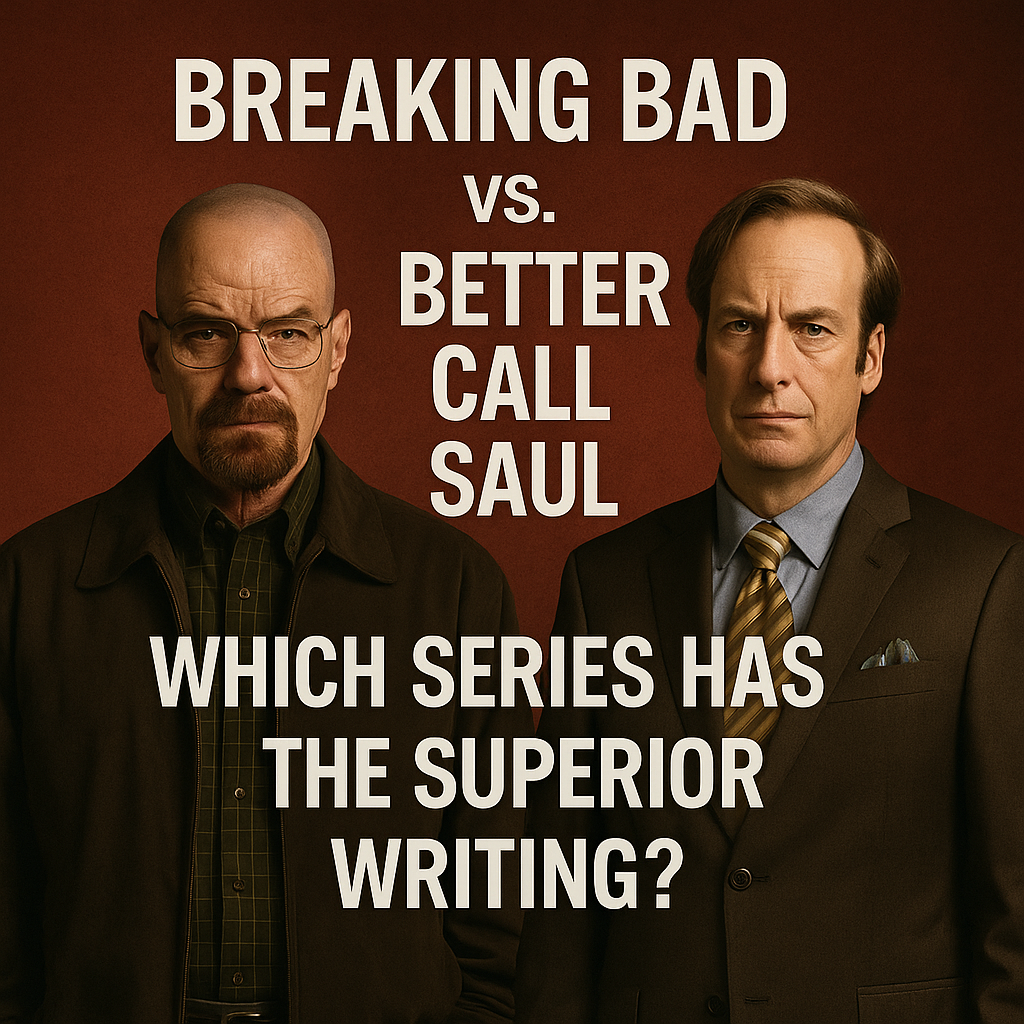
Few TV debates are as heated—or as meaningful—as the question:
Which one is better written: Breaking Bad or Better Call Saul?
Both shows come from the same creative universe, share core writers, and revolve around morally complex men making catastrophic decisions.
But their approaches to storytelling are radically different.
This analysis breaks down five writing pillars to determine which series truly stands above the other:
- Character development
- Narrative structure
- Dialogue & subtext
- Themes & symbolism
- Emotional payoff
By the end, the answer becomes surprisingly clear… and it may not be the one you expect.
1. Character Development: Depth vs Transformation
⭐ Breaking Bad — The Greatest Character Transformation Ever Written
Walter White’s journey from meek chemistry teacher to brutal criminal mastermind is television’s most famous transformation.
Key traits of the writing:
- Every decision is logical
- Every step feels inevitable
- The descent is slow but unstoppable
- Walter becomes the truest version of himself
Breaking Bad is character transformation done with surgical precision.
⭐ Better Call Saul — The Most Complex Character Study Ever Written
Jimmy McGill’s journey to Saul Goodman—and then to Gene Takavic—is far more subtle.
Traits of the writing:
- Transformation is internal
- The wounds of childhood shape present behavior
- Morality erodes through tiny choices
- The tragedy is that Jimmy could have been great
Better Call Saul is character excavation.
It digs deeper than Breaking Bad, revealing layers of identity, guilt, coping mechanisms and emotional trauma.
✔ Winner: Better Call Saul (by a small margin)
Breaking Bad has the bigger arc.
Better Call Saul has the deeper one.
2. Narrative Structure: Speed vs Precision
⭐ Breaking Bad — High-Stakes, High-Velocity Storytelling
The show is built around:
- escalating danger
- tight plotting
- cliffhangers
- twists
- forward momentum
It’s a masterclass in tension.
⭐ Better Call Saul — Slow-Burn Complexity
Saul is quieter, slower, more literary.
Traits of the structure:
- small decisions have big consequences
- long-term character arcs
- parallel timelines (Jimmy/Saul/Gene)
- episodes that feel like short films
- storylines built on emotional logic, not shock value
This is a show made for patient, thoughtful viewers.
✔ Winner: Breaking Bad
No series matches its pacing and escalation.
Better Call Saul is intentionally slower; Breaking Bad is engineered for tension.
3. Dialogue & Subtext: Who Writes the Better Words?
⭐ Breaking Bad
Dialogue is sharp, iconic, meme-level memorable:
- “I am the one who knocks.”
- “Stay out of my territory.”
- “Say my name.”
But it leans toward heightened drama.
⭐ Better Call Saul
Dialogue is quieter, more human, more layered.
Examples:
- Chuck’s cold precision
- Kim’s internal war between ethics and thrill
- Jimmy’s charismatic manipulation
- Gus’s philosophical menace
Every conversation hides a deeper emotional truth.
Dialogue is not about sounding cool —
it’s about revealing suppressed desires, wounds and contradictions.
✔ Winner: Better Call Saul
It’s the more mature, more nuanced scriptwriting.
4. Themes & Symbolism
⭐ Breaking Bad
Themes revolve around:
- ego
- pride
- corruption
- masculine power fantasy
- the destruction of the family unit
Symbolism is bold and sometimes obvious:
- color motifs
- chemical metaphors
- Heisenberg persona
- the blue meth as identity
Breaking Bad is operatic, almost Shakespearean.
⭐ Better Call Saul
Themes revolve around:
- self-worth
- guilt
- honor
- identity
- cycles of abuse
- the tragedy of wasted potential
Symbolism is quieter:
- Chuck’s electricity illness
- Kim’s ponytail (control)
- the tequila bottle cap
- Saul’s loud suits as armor
- the black-and-white Gene timeline
Better Call Saul’s themes hurt more because they feel like real life, not myth.
✔ Winner: Better Call Saul
This is where the show achieves brilliance.
5. Emotional Payoff: The Final Question
⭐ Breaking Bad — Satisfying, Explosive, Iconic
The finale gives viewers exactly what they want:
- redemption
- revenge
- closure
- catharsis
It’s big, loud, cinematic.
⭐ Better Call Saul — Painful, Honest, Human
The finale is devastating precisely because it isn’t crowd-pleasing.
Jimmy’s final confession is the culmination of everything the show is about:
- identity
- accountability
- the price of transformation
It is the most emotionally mature ending in the universe.
✔ Winner: Better Call Saul
It hits harder because it means more.
⭐ Final Verdict: Which Has the Superior Writing?
🟩 Best written overall: Better Call Saul
(Yes, seriously.)
🟦 Most thrilling & iconic: Breaking Bad
🟪 Most emotionally complex: Better Call Saul
🟨 Most rewatchable: Breaking Bad
In pure writing craft — thematic depth, subtext, character psychology, narrative precision —
Better Call Saul edges out Breaking Bad.
It’s a more mature work.
A more patient work.
A more literary work.
Breaking Bad will always be more iconic.
But Better Call Saul is the one writers study.