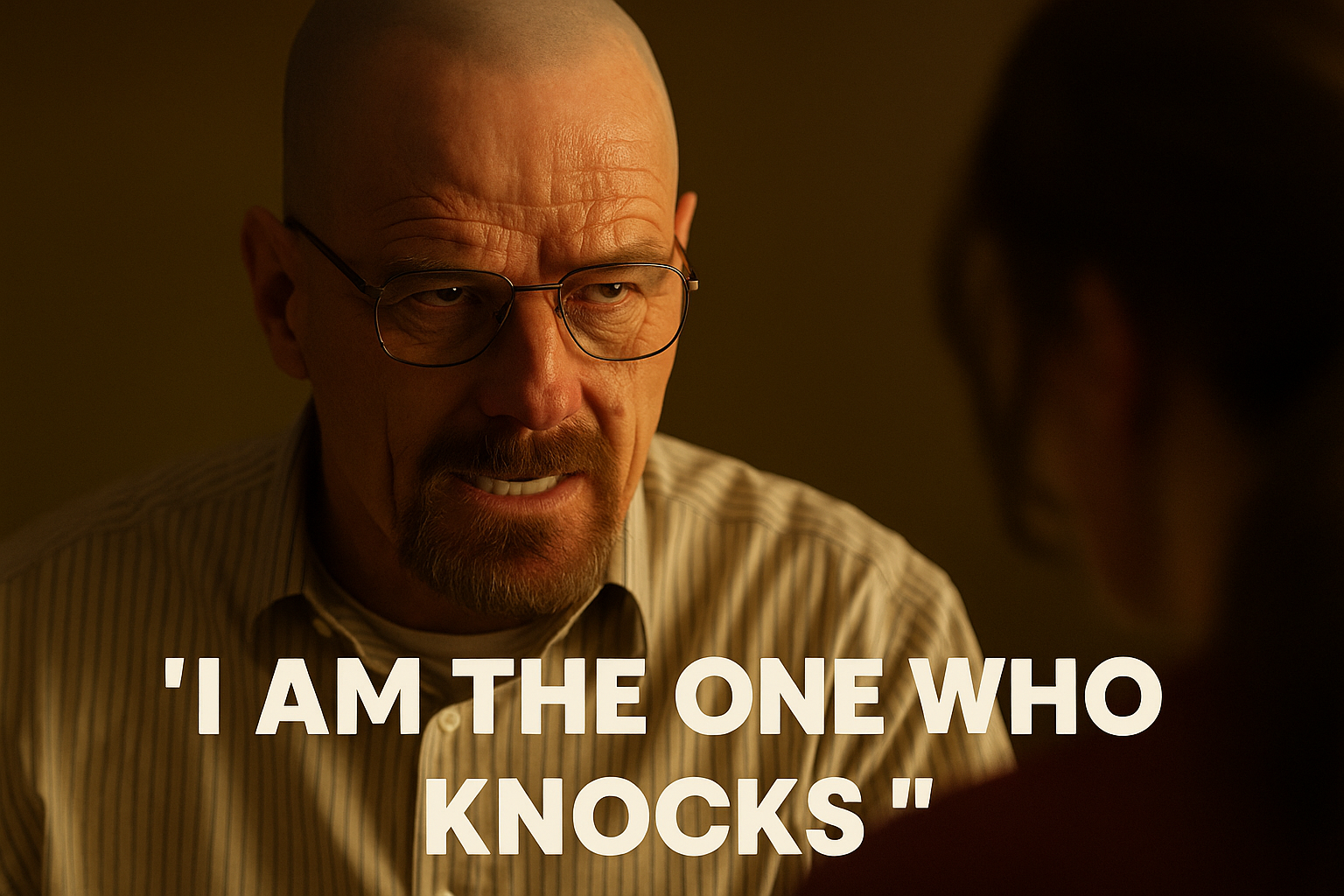
Few moments in television history have crystallized a character’s transformation as powerfully as Walter White’s iconic declaration:
“I am not in danger, Skyler…
I AM the danger.”
This is the moment Walter White ceases to exist
and Heisenberg is born — not in the drug world, but in his family home.
In this breakdown, we’ll analyze:
- performance
- lighting
- camera work
- blocking
- thematic context
- psychological underpinnings
…and why this short scene became one of the most quoted lines in TV history.
🟥 1. Context: Fear Turns Into Power
Skyler confronts Walt about the danger he is putting the family in.
She believes Walt is a victim of violent criminals.
Walt knows the truth:
He IS the violent criminal.
This tension becomes the emotional engine of the scene.
🟥 2. The Room: Domestic Space as a Battlefield
The scene takes place in:
- a quiet bedroom
- warm lighting
- personal space
- soft textures (bedspread, walls)
It’s deliberately non-threatening.
This contrast makes Walter’s transformation more terrifying:
Evil doesn’t arrive with explosions.
Evil sits on the edge of a bed and speaks calmly.
🟥 3. Performance: Bryan Cranston’s Controlled Explosion
Cranston plays Walt with extraordinary restraint:
Early in the scene:
- gentle tone
- soft posture
- empathetic expression
- reassuring body language
As Skyler presses:
- micro-changes begin
- voice drops
- breathing shifts
- eyes sharpen
- shoulders rise
This is not anger — it is ego awakening.
Cranston transitions from timid to terrifying without raising his voice.
The stillness makes it worse.
🟥 4. The Line Delivery: Why It’s Iconic
The famous line is delivered in two stages:
Stage 1:
“I am not in danger, Skyler.”
Calm.
Flat.
Measured.
A lie.
Stage 2:
“I am… THE danger.”
Voice deepens.
R.-E.-S.-O.-N.-A.-N.-C.-E.
Pauses become weapons.
He stares straight through Skyler.
Cranston drops all softness.
Heisenberg arrives at full force.
This is Voldemort saying his name.
This is a god revealing himself.
🟥 5. Blocking: Walter Moves Into Dominance
Watch how Walt’s body shifts:
- He sits higher as he speaks
- He leans forward
- Skyler sinks back
- The space between them tightens
- Walt fills the frame
- Skyler gets cropped to the edge
This is spatial domination.
The camera doesn’t move much —
the characters move inside the frame to show the power shift.
🟥 6. Camera Work: Subtle, Slow, Suffocating
Breaking Bad rarely uses flashy camera movement in emotional scenes.
Here:
- slow push-in on Walt
- slight tilt to emphasize height
- medium close-ups
- low angle when Heisenberg emerges
- warm domestic lighting turned sinister
The camera language mirrors Walt’s transformation.
The gentle room becomes a throne.
🟥 7. Skyler’s Reaction: The Birth of Fear
Anna Gunn’s performance is essential.
Skyler goes through:
- confusion
- disbelief
- realization
- terror
Her pupils widen.
Her breathing changes.
She physically recoils.
We aren’t seeing a wife arguing with her husband.
We’re seeing a woman realizing:
The man she married is gone.
Heisenberg is in their house.
And he does not see himself as the victim.
He sees himself as the predator.
🟥 8. Sound Design: Silence as Pressure
There is no score.
The silence amplifies:
- breathing
- clothing movement
- vocal resonance
- ambient room tone
The lack of music traps the viewer in the room.
You cannot escape the tension.
🟥 9. Why This Scene Works: It Redefines the Series
Up until this point:
- Walt is a dying chemistry teacher
- Walt is struggling financially
- Walt is manipulating for survival
But after this line:
He becomes a man who believes he deserves power.
The line is not about bravado.
It is self-realization.
Walt stops performing confidence.
Walt becomes confidence.
He becomes the threat.
This scene is the spiritual midpoint of the entire series.
🟥 10. Final Meaning: The Moment Walter White Truly Dies
Narratively, this scene marks:
- the death of Walter White
- the dominance of Heisenberg
- the beginning of Skyler’s terror
- the collapse of the family dynamic
- the irreversible step into villainy
He didn’t raise his voice.
He didn’t use violence.
He didn’t even stand up.
He simply told the truth:
He is the danger.
And it changes everything.