Why Rust Cohle Remains One of TV’s Most Complex Philosophical Creations
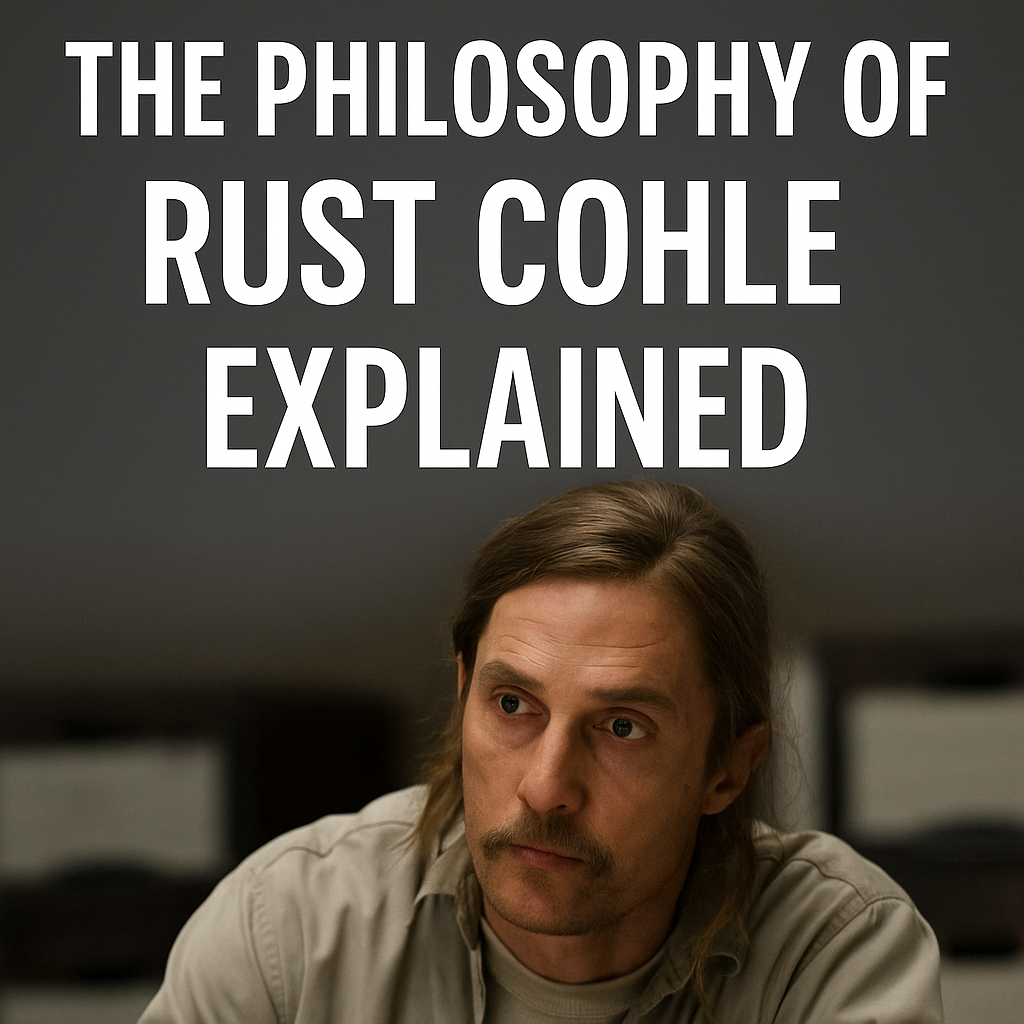
Rust Cohle isn’t just a character.
He is a worldview.
Nic Pizzolatto built True Detective around a deeply existential core, and Matthew McConaughey shaped Rust into one of the most intellectually demanding protagonists in modern television. His monologues, moral logic, and haunted psychology elevate the character beyond crime drama — into pure philosophical territory.
This analysis breaks down the intellectual framework behind Rust Cohle:
his nihilism, trauma, metaphysics, ethics, and why his worldview matters.
🟦 1. Rust Cohle as a Philosophical Archetype
“I think human consciousness is a tragic misstep in evolution.”
Rust represents a unique fusion of:
- antinatalism
- nihilism
- Schopenhauer’s pessimism
- Cioran’s despair
- existential trauma
- flat-circle metaphysics
He isn’t a pure nihilist.
He is a traumatized metaphysicist—someone who built a worldview to survive the unbearable.
Rust’s philosophy is less an ideology and more a coping mechanism shaped by suffering.
🟦 2. Trauma as the Engine of His Metaphysics
Rust’s intellectual darkness is born from personal catastrophe:
- the death of his daughter
- the collapse of his marriage
- years undercover with violent criminals
- chemical abuse
- social isolation
- existential burnout
His philosophy is not academic—
it’s experiential.
Rust sees the world as hostile, predatory, and indifferent because his life has shown him nothing else. His worldview is the only way he can make sense of cruelty without being destroyed by it.
🟦 3. Cohle’s Nihilism: Life as Self-Deception
“We are things that labor under the illusion of having a self…”
Rust denies all comforting illusions:
- identity
- meaning
- narrative
- morality
- purpose
- free will
His core belief:
Humans invent reasons to justify existence, because the alternative — meaninglessness — is unbearable.
This makes him radically honest in a way most characters are not.
He is not depressed.
He is lucid.
🟦 4. Time and the “Flat Circle”
“Time is a flat circle.”
One of Rust’s most iconic statements.
This idea blends:
- Nietzsche’s eternal recurrence
- deterministic physics
- trauma loops
- the inability to escape the past
To Rust, time is:
- cyclical, not linear
- repetitive, not progressive
- oppressive, not redemptive
This philosophy explains why he believes people don’t change—they merely repeat patterns written by trauma and biology.
Rust isn’t hopeless.
He’s deterministic.
🟦 5. Rust’s Moral Logic: The Paradox of the Nihilist Detective
Rust believes life has no meaning — yet he relentlessly pursues justice.
This is the Rust Cohle paradox.
If nothing matters, why chase monsters?
Because Rust’s morality is self-authored.
His code is not spiritual or societal.
It is internal.
He can’t save the world.
But he can reduce suffering where he finds it.
In a meaningless universe, the smallest act of good becomes an act of rebellion.
Rust is a nihilist with a moral spine.
🟦 6. Cohle the Existential Detective
Rust represents the archetype of the detective who sees too much.
His skills come from:
- pattern recognition
- emotional detachment
- obsessive focus
- anti-social psychology
- a willingness to confront darkness
- inability to look away
He is built for a job that is slowly killing him.
He is the perfect detective because he is already broken.
🟦 7. The Hart–Cohle Duality: Order vs. Truth
Rust and Marty are philosophical opposites:
- Marty wants comfort
- Rust wants truth
- Marty lives in denial
- Rust lives in clarity
- Marty protects illusions
- Rust destroys them
Their friction is the moral heart of the show.
Rust forces Marty — and the audience — to confront the lies society is built on.
Marty forces Rust to confront the possibility that meaning exists between people.
🟦 8. The Finale: The Light vs. Dark Monologue
“Once there was only dark. If you ask me, the light’s winning.”
This is one of TV’s most surprising philosophical turns.
Rust does not abandon nihilism.
He doesn’t suddenly believe in God, karma, or purpose.
He simply experiences:
- connection
- peace
- acceptance
- emotional warmth
- the possibility of meaning in suffering
His worldview expands—
it does not reverse.
Rust discovers that small pockets of light can exist in an indifferent universe.
It’s a subtle but profound shift.
🟥 Conclusion: Why Rust Cohle Endures
Rust Cohle remains one of television’s greatest characters because he embodies the full spectrum of human philosophy:
- nihilism
- existentialism
- trauma
- moral rebellion
- logic
- despair
- honesty
- hope
He is a man trying to navigate a universe with no map —
and he forces viewers to confront the questions most people avoid.
Rust doesn’t offer answers.
He offers clarity.
And that’s why he remains iconic.