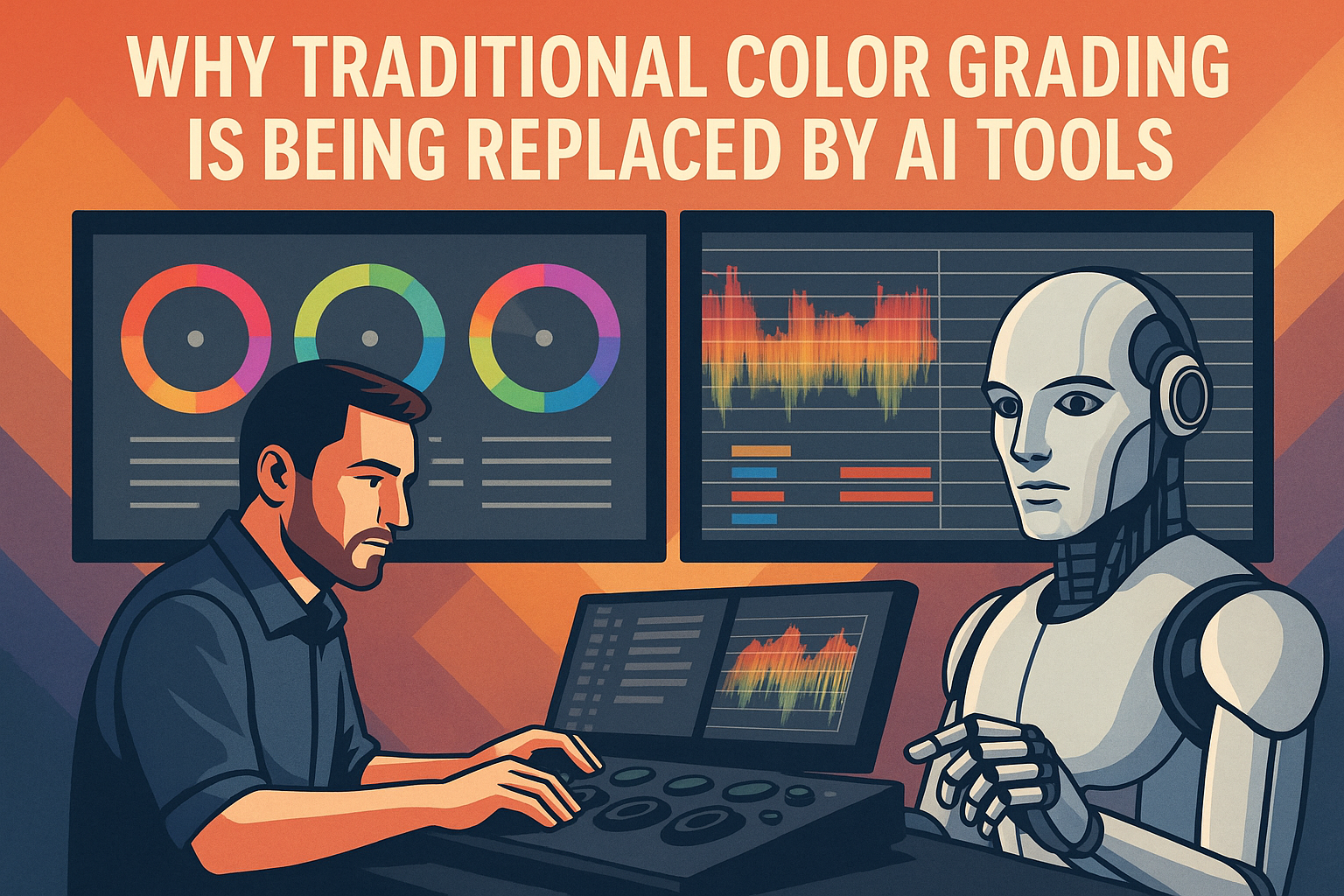
Inside the shift reshaping Hollywood’s color pipelines, DI workflows, and the future of the modern image.
Introduction: Hollywood’s Color Revolution Has Already Started
For more than a century, color grading has been a purely human craft — an artistic discipline performed by highly trained colorists in dark rooms using expensive control panels.
But in 2025, the industry is undergoing a profound shift:
AI is becoming the primary engine behind modern color workflows.
Studios are already integrating:
- neural color engines
- automated look-matching
- AI exposure balancing
- shot-to-shot color continuity
- AI-driven ACES transforms
- style-transfer tools
- deep learning-based skin tone preservation
- automated noise reduction
- predictive match-to-editorial
This doesn’t mean colorists are disappearing…
…but their role is rapidly evolving.
This article explains:
- why AI is taking over
- how today’s AI color systems work
- which traditional methods are being phased out
- how DI pipelines are changing
- what colorists will become
- and what the future of image finishing looks like
Let’s break down the real transformation happening inside Hollywood’s post houses.
🟥 1. Why AI Color Tools Are Taking Over (The 2025 Shift)
Three forces converged at the same time:
A) 4K/6K/8K Workflows Became Too Heavy
Modern productions shoot:
- 6K ProRes
- 8K RAW
- HDR10+
- Dolby Vision
- LogC4 (ARRI)
- RED V-RAPTOR 8K VV
- Sony Burano 8.6K
The amount of footage is massive.
Manual color prep and balancing is no longer scalable.
AI became essential for:
- automated normalization
- exposure leveling
- base look generation
- noise classification
- scene detection
B) Post-Production Schedules Shrunk
Studios now demand:
- faster turnarounds
- instant reshoots
- simultaneous theatrical + streaming deliverables
- multi-format output (SDR, HDR, HLG, Dolby Vision)
The old DI pipeline simply can’t keep up.
AI is the only practical accelerator.
C) AI Became Extremely Good at Style Transfer
2025 AI color models can:
- copy the exact look of Her, Dune, Blade Runner 2049, or Euphoria
- replicate cinematographer LUTs
- match entire sequences instantly
- reproduce film stock characteristics
- maintain skin tone integrity
Traditional grading can’t compete with this speed at scale.
🟥 2. How AI Color Grading Actually Works (Technical Breakdown)
AI color systems use multiple neural networks running in parallel.
Here’s the simplified architecture:
⭐ 1. Scene Analysis Network (SAN)
Detects:
- interior/exterior
- weather
- lighting type
- skin tones
- objects
- faces
- highlights and contrast
- color cast issues
This replaces hours of manual shot labeling.
⭐ 2. Exposure Normalization Engine
Creates a perfect technical baseline:
- balances exposure
- fixes white balance
- normalizes contrast
- aligns gamma curves
This ensures all shots begin from a unified “neutral” starting point.
⭐ 3. Look Creation / Style Transfer Engine
This is where the magic happens.
AI models trained on:
- film stocks
- entire movies
- DP-specific looks
- LUT libraries
- colorist archives
…and generate a scene-specific look instantly.
AI can reproduce:
- Kodak 2383 film print
- Ektachrome
- “Villeneuve Desert Orange”
- ARRI–Alexa highlight rolloff
- HBO teal-and-copper tones
- “Apple TV+ prestige look”
This step used to require hours of manual artistry — now done in milliseconds.
⭐ 4. Continuity Model
Ensures:
- shot-to-shot consistency
- scene-level color continuity
- exposure/event-based transitions
- no flicker
- no tone drift
Traditionally this was one of the hardest tasks in grading.
AI handles it perfectly.
⭐ 5. Skin Tone Protection Model
AI maps human skin in LAB / HSV color space and preserves:
- undertones
- highlight rolloff
- luminance integrity
This prevents the classic problem:
“Great look, but skin tones broke.”
🟥 3. The Death of Traditional Prep: What AI Has Already Replaced
1. Shot balancing → AI
2. Base LUT creation → AI
3. Look matching → AI
4. Continuity correction → AI
5. Noise reduction → AI
6. Technical ACES transforms → AI
7. White balance correction → AI
8. Shadow/highlight rescue → AI
This frees colorists from 70% of the repetitive work.
Their role is now more like:
- taste maker
- finalizer
- supervisor
- creative director
Colorists are evolving into image architects, not technical operators.
🟥 4. How AI Is Reshaping the DI Pipeline (Modern Workflow)
Traditional DI Pipeline:
- Conform
- Balance shots
- Apply LUT
- Develop look
- Grade sequence
- Fix continuity
- Noise reduction
- Sharpen / cleanup
- Output formats
2025 AI Pipeline:
- Ingest footage
- AI exposure + WB normalization
- AI look transfer
- AI continuity pass
- AI noise and grain
- Colorist creative pass
- Delivery formats auto-generated
AI eliminates half the manual pipeline.
🟥 5. Why Studios Love AI Color (Money & Scale)
A) Cost Efficiency
AI reduces:
- labor hours
- multi-day shot matching
- overtime in DI suites
- manual rebalancing
B) Faster Delivery
Studios can go from offline → color → delivery in record time.
C) Multi-Format Output
AI handles:
- HDR
- SDR
- Dolby Vision
- YouTube
- TikTok vertical
- Regional tone variations
D) Reshoot Integration
AI matches reshoot footage to original color in seconds.
🟥 6. The Big Threat: Will AI Replace Colorists?
Short answer: No. But the job is changing completely.
AI replaces:
- mechanical grading
- base corrections
- continuity
- repetitive adjustments
…but not:
- creative look development
- narrative shaping
- emotional tone crafting
- director–DP collaboration
- final decisions
Colorists will become:
“Creative color directors”, not “technical graders.”
🟥 7. The Future (2025–2035): Where This Is All Going
1. Full AI Auto-DI
Entire films may be graded by AI with colorist supervision.
2. Personalized Color Grades
Different viewers could receive different:
- contrast levels
- color temperature
- saturation levels
- tone mapping
(based on device, environment, preferences)
3. Director-Trained AI Models
Every major director will train their own style model.
4. Real-Time On-Set AI Grading
Look development will happen during shooting, not in post.
5. Neural Film Emulation (Beyond LUTs)
Real film texture synthesized by neural networks.
🟥 Conclusion: AI Isn’t Replacing Colorists — It’s Replacing the Old Workflow
Color grading is not dying.
But the era of:
- manual balancing
- slow look creation
- continuity wrestling
- heavy technical prep
is over.
AI is transforming color from a technical bottleneck into a creative playground.
Colorists now focus on:
- taste
- emotion
- narrative tone
- artistic identity
And that shift is pushing Hollywood further into a future where images are crafted faster, smarter, and with deeper creative intention.
Hyper-automation is not the end of artistry — it’s the beginning of its evolution.