How AI, data, and emotional modeling are turning Netflix, Amazon, Disney, and Apple TV+ into fully adaptive entertainment ecosystems.
🟥 Introduction: The Era of “One-Size-Fits-All Streaming” Is Over
For more than a decade, streaming platforms relied on a simple premise:
Everyone gets roughly the same interface, the same categories, and the same promotional materials.
That model is now gone.
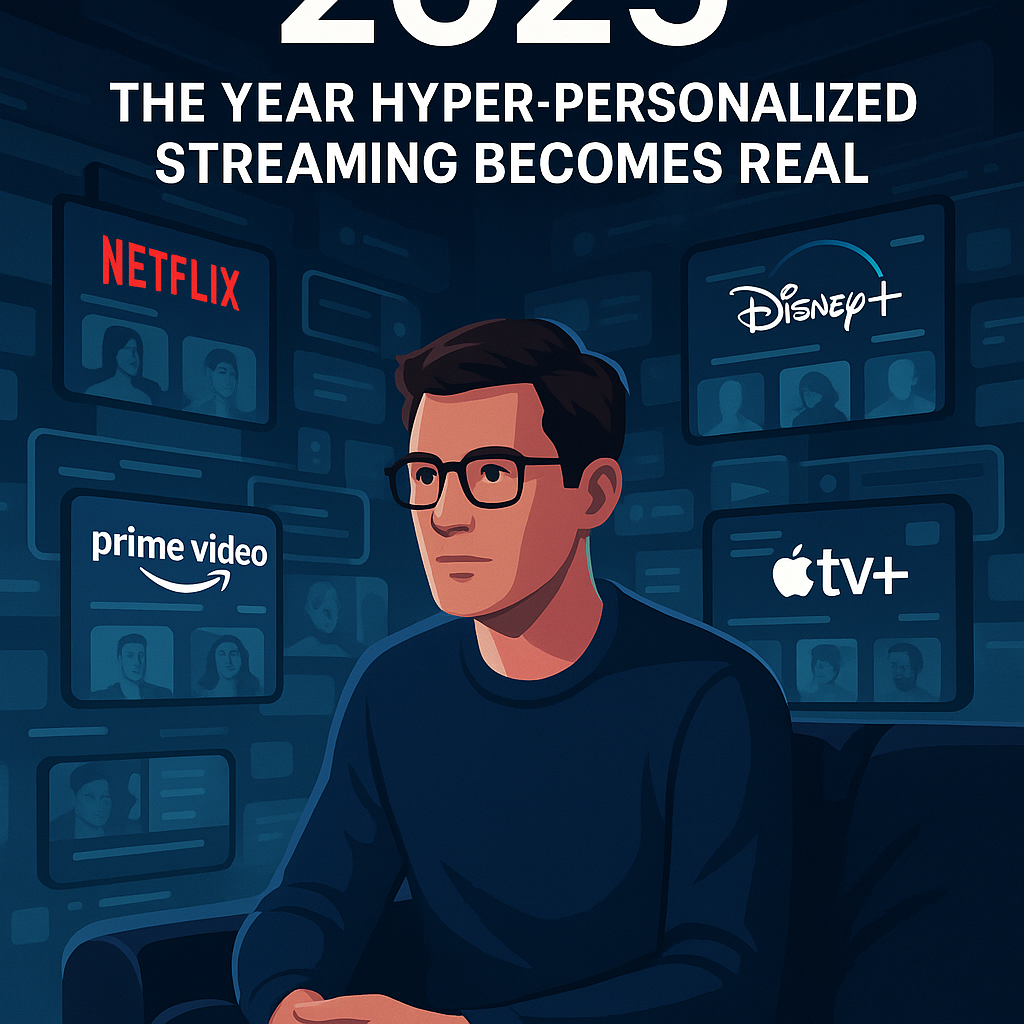
In 2025, Netflix, Amazon Prime Video, Disney+, Max, and Apple TV+ have quietly moved toward a radical new paradigm:
Every viewer will eventually get their own version of the platform.
Not just different recommendations — an entirely different streaming experience.
Hyper-personalization is no longer a buzzword. It’s happening right now:
- Personalized homepages
- Personalized thumbnails
- Personalized trailers
- AI-generated marketing for each viewer
- Emotion-based recommendations
- Behavioral prediction models
- Real-time content curation
- Personalized “micro-genres”
- Platform interfaces that adapt to your mood
This transformation marks the biggest evolution in streaming since the shift from cable to Netflix.
In this deep dive, we explore:
- Why 2025 is the turning point
- How AI emotionally maps viewer behavior
- How platforms adapt dynamically to every user
- The long-term vision: fully personalized entertainment
🟥 1. The Global Shift: Why Hyper-Personalization Became Essential in 2025
Three forces pushed platforms into this new era.
A) Content Overload Is Out of Control
In 2025, the average user faces:
- 10,000+ titles per platform
- Dozens of new originals per month
- Endless third-party licensing cycles
- A constant scroll of “you might like” clutter
Users aren’t overwhelmed—they’re numb.
Platforms realized that recommending content isn’t enough.
They must predict what every individual wants before they want it.
B) Competition Became Hyper-Intense
Netflix, Prime Video, Disney+, Max, and Apple TV+ are fighting the same battle:
- Same audiences
- Same global markets
- Same attention limitations
Hyper-personalization became their differentiator:
- Netflix → emotional prediction
- Prime Video → behavioral pattern modeling
- Disney+ → family-centric AI segmentation
- Apple TV+ → high-precision taste modeling
- Max → tone-based content clustering
Each platform now invests in personalization because it’s the new competitive edge.
C) AI Infrastructure Finally Became Capable
2025 is the year when:
- LLMs
- multimodal models
- recommendation embeddings
- neural rendering
- on-device inference
- behavioral clustering AI
all matured enough to rewrite streaming entirely.
What once required massive compute now runs efficiently, cheaply, globally.
The timing was perfect.
🟥 2. The Core Technology Behind Hyper-Personalization: Emotional Data Modeling
The biggest breakthrough in 2025 isn’t “better recommendations.”
It’s emotional modeling.
Platforms now evaluate:
- your pacing preference
- your emotional response to scenes
- your binge patterns
- your tolerance for certain tones
- your reaction to music or intensity
- your interaction with subtitles
- your likelihood to quit a show early
- your sensitivity to violence or darkness
- your late-night vs weekend taste difference
This data produces emotional fingerprints unique to each viewer.
For example:
You don’t just “like dramas.”
You like:
- slow-burn dramas
- with minimal music
- morally ambiguous characters
- and 8–10 minute scene pacing
- usually during weekend nights
Another viewer might be:
- fast-paced thriller
- heavy soundtrack
- clear moral alignment
- binge-watching in small bursts
AI tracks thousands of micro-signals.
This is the difference between:
“People who liked this…”
and
“People who feel like you at this exact moment.”
That’s hyper-personalization.
🟥 3. How Platforms Adapt to Each Viewer: The New Recommendation Engine 3.0
Hyper-personalization affects not just what you watch—but everything you see.
Here are the 2025 features now deployed on major platforms:
A) Hyper-Personalized Homepages
No two viewers on Earth share the same layout.
The system adjusts:
- row order
- tile size
- color dominance
- content density
- prominence of originals
- placement of “continue watching”
- placement of new releases
- whether you see recommendations at all
Your homepage reflects your consumption habits, not generic design.
B) Personalized Thumbnails (The Manipulation Layer)
By 2025, thumbnails are:
- AI-generated
- A/B tested
- Emotion-matched
- Behaviorally optimized
- Viewer-specific
Platforms use dozens of variations.
You see the one with the highest click-through probability for you personally.
For example:
- If you click on faces → close-up posters
- If you respond to colorful visuals → saturated designs
- If you prefer mystery → shadow-heavy covers
- If you like romance → couple imagery
This is one of streaming’s most powerful psychological tools.
C) Personalized Trailers (2025’s New Breakthrough)
Platforms began generating AI-re-edited trailers based on viewer taste patterns.
Apple TV+ and Netflix are leading this.
If you prefer emotional arcs → trailers emphasize character drama
If you prefer action → fight scenes dominate
If you prefer mystery → cryptic clues highlighted
Trailers are no longer universal—they are algorithmic.
D) Personalized “Micro-Genres”
2025 platforms no longer rely on simple categories like:
- Drama
- Comedy
- Action
Instead, viewers now see “micro-genres” such as:
- “Moody Sci-Fi with Emotional Depth”
- “Fast-Paced Heist Stories”
- “Cerebral Thrillers with Philosophical Themes”
- “Feel-Good Weekend Escapes”
- “Female-Led Character Dramas”
These categories are generated on the fly.
E) Personalized Release Timing (Yes, this is real)
Some platforms adjust when shows are promoted to you.
- Weekend watchers receive weekend pushes
- Night viewers see dark-toned suggestions
- Light morning watchers get short-form content
- Binge users receive multi-episode drops
This turns a unified platform into millions of micro-platforms.
🟥 4. Case Study: How Each Streaming Giant Uses Hyper-Personalization
Let’s break down how the major players use personalization in 2025.
⭐ Netflix — Emotional Prediction Engine
Netflix is the king of personalization, using:
- embeddings
- sentiment analysis
- emotion modeling
- visual dominance detection
- linguistics patterning
- cross-cultural behavior modeling
They know when you’re likely to quit, binge, explore, or freeze.
Their goal:
reduce choice paralysis and maximize “flow state” watching.
⭐ Amazon Prime Video — Behavioral Propensity Modeling
Amazon uses:
- Amazon retail data
- voice activity (Alexa)
- viewing patterns
- device patterns
- contextual data
Their personalization is “economic”—they optimize for session time and retention probability more than emotional resonance.
⭐ Disney+ — Family-Structured Personalization
Disney’s biggest advantage:
They personalize by household profile clusters, not individuals.
Examples:
- “Parent + Teen” pattern
- “Young family” pattern
- “Adult nostalgia” pattern
Their AI prioritizes safety, predictability, and positivity.
⭐ Apple TV+ — Taste Purity Modeling
Apple’s personalization is small-scale but elite.
They emphasize:
- premium originals
- artist credibility
- critical acclaim
- tone consistency
Apple predicts your refined taste evolution, not your raw behavior.
⭐ Max — Mood and Tone Classifier
Max doesn’t rely on genre—they classify shows by:
- mood
- pacing
- color palette
- narrative complexity
- character typing
Their personalization feels like a curated film festival.
🟥 5. Hyper-Personalized Ads, Marketing, and UI (The Quiet Revolution)
2025 marks the year when personalization moves beyond content.
Platforms now adapt:
- homepage backgrounds
- font size
- brightness
- section layout
- trailer autoplay intensity
- color palettes
This is not random.
It’s based on:
- viewing distance
- age markers
- screen size
- light sensitivity
- accessibility patterns
Your streaming interface literally reshapes itself to your usage.
🟥 6. Privacy & Ethics: The Dangerous Side of Hyper-Personalization
This shift raises major concerns:
A) How much emotional data should platforms track?
Netflix may know when you are stressed, sad, bored, or lonely.
B) Should AI manipulate your mood for engagement?
Algorithms may push certain shows not because they’re good for you—but because you’re vulnerable.
C) Can “mood data” become a commercial product?
Advertising ecosystems already want it.
D) Could platforms predict psychological traits?
Yes, and some already do.
The industry is entering ethically grey territory.
🟥 7. The Future (2025–2030): Toward Fully Personalized Entertainment
By 2030, hyper-personalization may create:
1. Personalized Story Cuts
Certain viewers may get:
- extended scenes
- different pacing
- alternate edits
- new music
- character focus shifts
2. Personalized Episode Order
AI might reorder episodes for narrative clarity.
3. Personalized Actors
Digital doubles for certain audiences.
4. Personalized Dialogue
LLMs may rewrite dialogue dynamically.
5. Personalized Endings
AI-generated finales for different viewers.
Streaming will stop being a “shared experience” and become a tailored journey.
🟥 Conclusion: Entertainment Is No Longer Universal — It’s Personal
2025 marks the moment streaming stops being:
“What’s popular?”
and becomes
“What’s optimal for you?”
Hyper-personalization transforms:
- content
- presentation
- emotional impact
- engagement
- viewer identity
- entertainment culture
Streaming is no longer a single product.
It is millions of parallel experiences, shaped uniquely for each individual.
The future of streaming isn’t about choice.
It’s about precision.